Chipped Japanese Knife: Honing Rods, Sharpeners and Repair
Researched. This guide compiles what Japanese knife makers and knife shops publish about chipped edges, honing rods, pull-through sharpeners and repair services (KAI, Kai USA/Shun, Tojiro, Global, Jikko, Sakai Ichimonji Mitsuhide, MAC, Korin, Kamata Hakensha and Kama-Asa), checked on October 7, 2026. We have not tested these tools or services. Always follow the instructions for your own knife first. This article contains no affiliate links.
A chip in the edge is one of the most common problems reported with thin, hard Japanese kitchen knives. Makers publish their own explanations of why it happens, what can be repaired, and where honing rods and pull-through sharpeners fit in. They do not always agree, so this guide sets their statements side by side.
In short: Makers attribute most chips to bones, frozen food, hard produce and sideways force on the blade. KAI, Jikko and Sakai Ichimonji Mitsuhide say chips can be ground out on a coarse whetstone, and several makers and shops publish repair fees and size limits. Makers disagree about honing rods, and KAI, Tojiro and Global describe pull-through sharpeners as a temporary or supplementary measure.
Why Japanese knives chip: what makers say
Kai USA, which sells Shun, says in its FAQ that fine Japanese knives are harder, thinner and sharper than comparable European-style knives and are built for keenness and edge retention rather than toughness. The makers we checked list the following causes and cautions.
- KAI: a knife has enough strength for the straight force of cutting, but may break if a force that bends the edge, such as prying or twisting, is applied after it has cut into food. KAI advises moving the knife straight back and forth.
- Sakai Ichimonji Mitsuhide: names three typical causes: stronger force than expected (most often fish bones and crab-type shells, cut by striking or pressing down), sideways force from twisting, and frozen food. It says the thin blade is strong against vertical force but extremely weak against force from the side, and that knives must not be used on frozen ingredients. It also says striking the cutting board hard can chip the edge, and suggests not slamming the knife down or using a soft wooden board.
- Jikko: says chips often come from hitting the corner of a sink, cutting fish bones, or cutting frozen meat or fish that has not been thawed. On pumpkin, it says that when the blade stops partway people tend to pry it left and right, and that this motion causes chips; it advises pulling the knife out and cutting again. For fish bones and hard items it recommends a deba.
- Global (Yoshikin): says not to cut frozen food or ice, to avoid hard foods (it lists pumpkin, corn, dried mochi and bones), not to twist or work the blade from side to side, or chop by striking, to use a soft board of wood or plastic, and to avoid strong impacts such as dropping the knife in the sink or on the floor.
- Tojiro: does not recommend dishwashers, partly because the water jets can knock the edge against other dishes or the basket and chip it.
- Kai USA (Shun): says not to use Shun knives on bones, joints or frozen foods, to cut with a smooth slicing motion rather than up-and-down chopping, and, if the knife sticks in hard food, to lift it straight up rather than twist it. Its FAQ adds that knives get knocked around in a dishwasher, that hard cutting surfaces can chip the blade, and that corrosion at the edge or an unaddressed rolled edge can also lead to chipping.
- MAC (USA): lists foods it considers too hard to cut with a knife: frozen items, bones, shellfish shells, hard squashes, hard cheeses, nut shells and blocks of chocolate.
- Korin: asks customers not to cut extremely hard or frozen items (it gives bones, seeds and metal as examples).
Our Japanese knife care guide covers washing, drying, cutting boards and storage in more detail.
What to do with a chipped edge
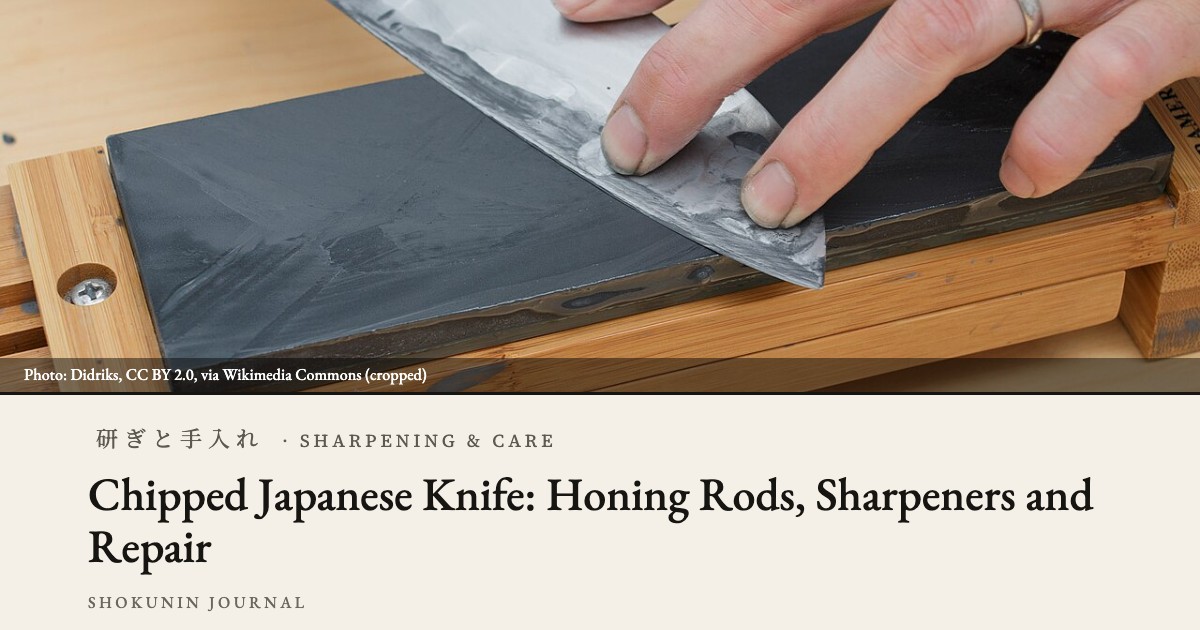
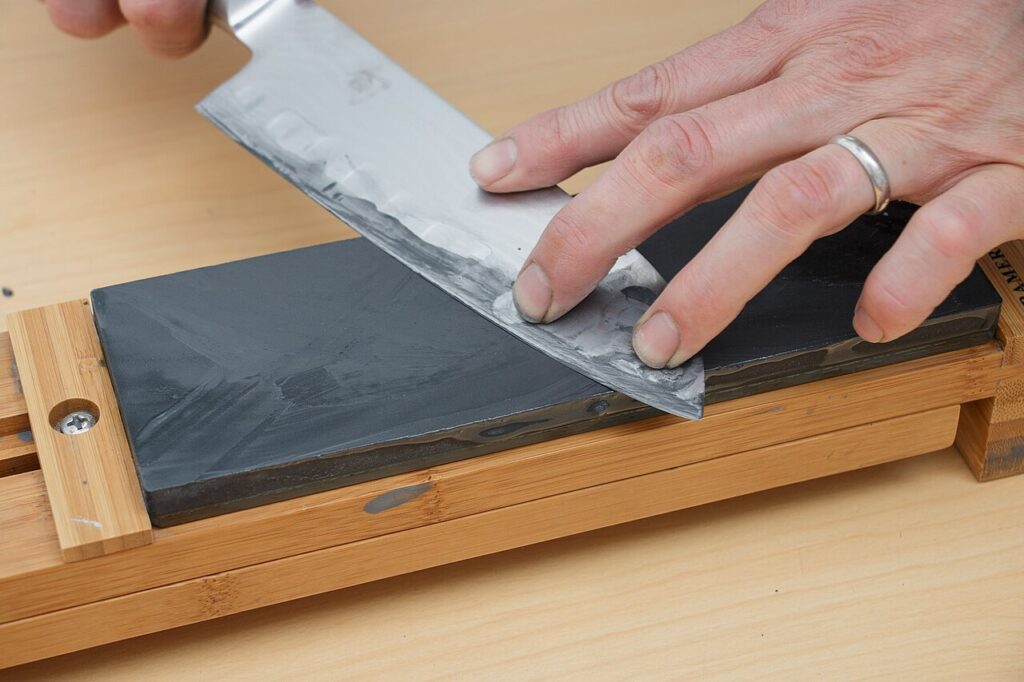
Grinding the chip out on a whetstone
- KAI: says small chips are repaired with a coarse whetstone, giving #300–#400 as a guide for coarse stones, followed by a medium and then a finishing stone.
- Jikko: says to grind the chipped area on a coarse stone, then use medium and finishing stones. It says even a large chip can be repaired, but that a very large one takes time and is better left to a knife shop. It also notes that removing a 5 mm chip makes the edge 5 mm shorter.
- Sakai Ichimonji Mitsuhide: says chips, small or large, can be restored by proper resharpening, but that a large chip takes some effort and several stones, and that a professional sharpener can be asked instead.
- Global (Yoshikin): says whetstone sharpening is the best care for any knife. Its FAQ says a chip up to about the size of a grain of rice can be handled by its resharpening service, and larger chips can be reshaped for an added repair fee.
- Tojiro: says home sharpening on a whetstone can restore the edge but that it is difficult to correct blade thickness and shape at home, and recommends a professional resharpening every few years.
- Kai USA (Shun): says micro chips can easily be sharpened out.
For grit ranges and how makers classify coarse, medium and finishing stones, see our guide to Japanese whetstones.
Repair and resharpening services: published fees and conditions
The figures below are what each maker or shop published on October 7, 2026. Several describe their prices as guides, with the final price set after the knife is inspected. Most of the Japanese pages describe domestic services; check the current page, and whether the service is available where you live, before sending a knife.
| Service | Knives accepted | Published fee | Chips | Turnaround |
|---|---|---|---|---|
| KAI (Japan online store) | KAI products only; other makers’ knives are not accepted. | Western and Japanese knives: ¥2,500 incl. tax within A4 size (32 × 23 × 2.5 cm) with no shipping cost to the customer; ¥3,300 incl. tax plus customer-paid shipping if larger. Bread knives and Chinese cleavers: ¥4,000 within A4 size, ¥5,500 if larger. | Paid option of ¥1,000 incl. tax per knife for chips of 1–3 mm. Chips of 4 mm or more cannot be handled. Chips under 1 mm need no option. | About 2–4 weeks for resharpening, after a packing kit that arrives in about 2–5 days |
| Tojiro | Tojiro products only. Wave-edged knives are not accepted. | Guide prices: ¥770–990 (70–150 mm), ¥1,100 (165–180 mm), ¥1,210 (200–210 mm), from ¥1,320 (240 mm and up). Shipping is paid by the customer. | About 1 mm: included in the basic fee. 3 mm or less: from +¥330. Larger than 3 mm: from +¥550. | About 7–14 business days |
| Global (Yoshikin) | Yoshikin’s own products only; other makers’ knives are not accepted. Some serrated models and some overseas-only models are excluded. | ¥1,980 incl. tax per knife. The customer pays shipping to Yoshikin; Yoshikin pays return shipping. | A chip up to about the size of a grain of rice is covered by resharpening. Larger chips add a repair fee of ¥2,200 incl. tax per knife. | About 7–10 days after arrival |
| Jikko | Jikko knives and knives from other makers. | Sharpening and repair: ¥5,500 (double-bevel), ¥6,050 (single-bevel), ¥6,600 (knives not made by Jikko), all incl. tax, plus shipping both ways. | A separate Jikko article gives chip repair as about ¥2,000 for a santoku and from ¥2,500 for a deba or sashimi knife, with an estimate after the knife is received. | About one week plus mailing time |
| Sakai Ichimonji Mitsuhide | Its own knives; it says it also accepts knives bought at other shops. | Price table by type and length, for example ¥1,760 for a santoku and ¥1,760 for a 180–210 mm gyuto. | Repairs needing chip removal or reshaping cost 50% to 100% more than the listed price. | About 10 days |
| Kai USA (Shun) | Kai and Shun cutlery. Kai USA tells buyers to check its lists of authorized and unauthorized dealers. Serrated knives are honed, not sharpened. | Sharpening is free; the owner pays shipping to Kai USA and a return shipping and processing fee of $15 (US) or $25 (Canada and Mexico). | Small chips of 2 mm or under can be sharpened out, which makes the blade narrower. Large chips or cracks in the blade are not repaired. | Estimated at 2 weeks |
| MAC Knife (USA) | MAC knives and other brands; no ceramic knives. | MAC knives: $8 (up to 6 in), $10 (over 6 in to 10 in), $12 (over 10 in). Other brands: $15, $20, $25. Shipping is a $6 flat fee regardless of the number of knives. | Chipped edge repair adds $4 (MAC) or $10 (other brands). No extra fee for chips less than 1/32 in deep. Chips must be 1/8 in deep or less to be repairable. | Usually within 5 business days; up to 10 in busy periods |
| Korin (New York) | All brands except scissors, serrated and ceramic knives. Two-knife minimum for mail-in. | Western-style double-sided knives: $25 for sharpening only. | $35 for the category covering major repair, chips, rust and thinning. | 2–3 days to process after arrival |
| Kamata Hakensha (Tokyo) | Accepts knives regardless of where they were bought. Knives can be sent by courier and are returned cash on delivery. | Basic fees: ¥800–1,000 for household and petty knives of 120–210 mm; ¥1,200–2,500 for gyuto and sujihiki of 240–330 mm. | Repairs chipped blades. Says additional fees may apply for reshaping or special materials. | Normally about one week |
| Kama-Asa (Tokyo) | Metal knives such as carbon steel and stainless steel are basically accepted. | Guide prices incl. tax for double-bevel knives: ¥1,650 (up to 15 cm), ¥2,200 (up to 21 cm), ¥2,750 (24 cm and up). Return shipping and cash-on-delivery fee: ¥1,210 + ¥330. | Says it will repair chipped knives as far as possible and asks customers to consult. Additional charges may apply for large chips, deformation or oversize knives. | About 1–3 weeks; can exceed one month |
Honing rods and sharpening steels
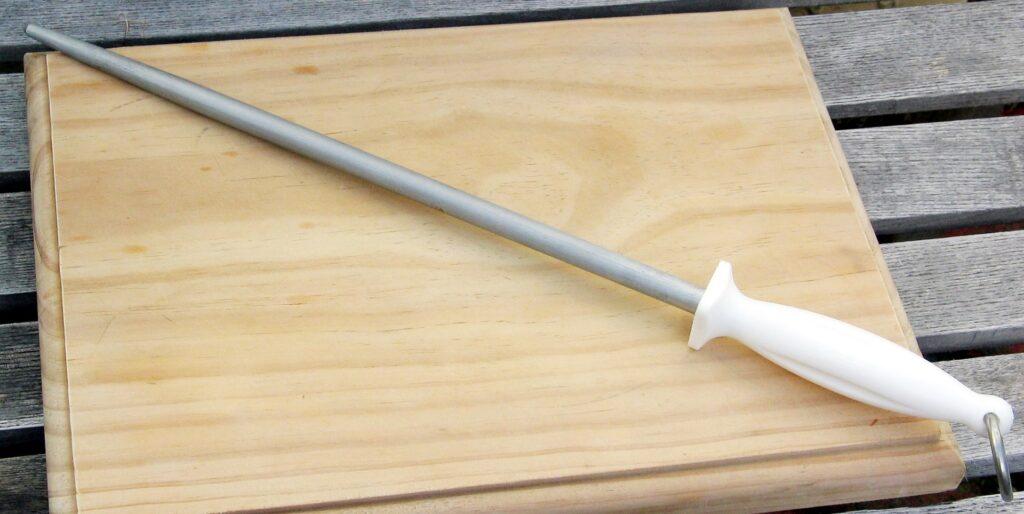
This is where the published advice differs most.
- Tojiro: describes the sharpening steel as a professional tool used mainly in meat processing to remove fat from the edge and correct it. It says a steel is not a substitute for a whetstone and only restores sharpness temporarily. Tojiro says steels suit lower-hardness stainless knives, such as European ones, and does not recommend them for carbon-steel (hagane) knives, because the hardness does not match and the steel damages the edge. Where a steel is used, it gives an angle of about 20 degrees.
- KAI: says a rod-type stone or file rod does not put an edge on a knife; its purpose is to remove oil and dirt from the blade and recover sharpness temporarily. KAI also notes that rods come with a diamond-coated or ceramic surface, and that some only remove fat from the blade.
- Kai USA (Shun): sells a honing steel and says honing realigns the edge without removing metal. Its steel has a built-in 16° guide, and it suggests honing about once a week depending on use. It says its ceramic rod, by contrast, removes material and should be used more sparingly. It also says regular honing can help prevent a rolled edge from becoming more vulnerable to chipping.
- MAC (USA): sells ceramic honing rods. It says ceramic is much harder than a traditional steel and has a finer grit, and that its black ceramic rod works well on harder Japanese steel knives. It suggests daily use in restaurants or once every few weeks at home, and says a rod only hones and does not replace sharpening.
- Korin: does not recommend honing steels on Japanese Western-style or traditional Japanese knives. It says steels are meant for realigning an edge and that using one may damage the knife or change its shape.
Pull-through and roller sharpeners
Several Japanese makers sell their own pull-through sharpeners and also publish their limits.
- KAI: calls them simple sharpeners for supplementary use when sharpness drops: handy, but it is hard to keep an edge sharp with them. It recommends a bench whetstone for full resharpening, with the simple sharpener alongside for everyday care. For its three-slot model, KAI says to use a dry knife and pull it toward you in one direction only, about 10 times in slot 1, about 10 in slot 2 and about 5 in slot 3. KAI says its electric sharpener can be used on carbon-steel and stainless knives but not on titanium or ceramic knives.
- Tojiro: says a sharpener does not truly sharpen; it roughens the edge so that it bites into food better for a while, and it cannot replace whetstone sharpening. It warns that relying only on a sharpener can greatly reduce edge strength and may cause cracks or chips. It notes that roller-type sharpeners have a fixed stone angle that may not match a given knife. Tojiro’s FAQ says sharpeners can be used on Tojiro knives, as everyday maintenance between whetstone or professional sharpening, and that the improvement is temporary.
- Global (Yoshikin): sells several sharpeners and says to use one when the knife feels dull, not after every use. It says a sharpener restores less sharpness than a whetstone, and that single-bevel, wave-edged and serrated knives generally cannot be sharpened with one. If its Speed Sharpener no longer restores sharpness, Global says the edge may be worn beyond what a sharpener can handle and suggests its resharpening service. It says its GLOBAL Sharpener Plus can correct minor chips.
- Kai USA (Shun): offers its Diamond and Ceramic Retractable Sharpener, which it says matches the 16° angle of Shun knives, and says an electric sharpener from another brand should sharpen to 16°.
- MAC (USA): says its knives can usually be maintained at home with its own Togu sharpener, a ceramic-wheel sharpener that MAC says is used with a back-and-forth motion rather than pulled through. It offers its sharpening service for knives that have become too dull or have small chips.
Side by side: where makers agree and disagree
“Not stated” means we found no statement on the official pages listed under Sources. It does not mean the maker approves or disapproves.
| Maker | Honing rod | Pull-through or roller sharpener | Chipped edge advice |
|---|---|---|---|
| KAI | Does not put an edge on a knife; removes oil and dirt for a temporary recovery. | Supplementary use; hard to keep sharpness. Whetstone for full resharpening. | Coarse whetstone (#300–#400 as a guide), then medium and finishing. Paid service for KAI knives; chips of 4 mm or more not handled. |
| Kai USA (Shun) | Sells a honing steel with a 16° guide; honing realigns without removing metal. | Offers its own 16° Diamond and Ceramic Retractable Sharpener. | Micro chips can be sharpened out. Free sharpening service handles chips of 2 mm or under; not large chips or cracks. |
| Tojiro | Not a whetstone substitute; suits lower-hardness stainless knives; not recommended for carbon-steel knives. | Can be used on Tojiro knives, but temporary; relying on it alone may weaken the edge. | Says repair is possible in most cases; the blade may become shorter or narrower. Paid service for Tojiro knives. |
| Global (Yoshikin) | Not stated | Use when the knife feels dull, not every time. Whetstone is the best care. | Resharpening service covers chips up to about a grain of rice; larger chips are repaired for an added fee. |
| Jikko | Not stated | Not stated | Coarse stone, then medium and finishing; very large chips are better left to a knife shop. |
| Sakai Ichimonji Mitsuhide | Not stated | Not stated | Chips can be restored by proper resharpening on coarse stones, or by a professional sharpener. |
| MAC (USA) | Sells ceramic honing rods; says they hone but do not replace sharpening. | Says its knives can usually be maintained with its Togu sharpener (a ceramic-wheel roller type, not a pull-through). | Service repairs chips up to 1/8 in deep. |
| Korin | Not recommended on Japanese knives; may damage the knife. | Not stated | Service has a fee category that covers chips. |
Staying safe
Repairing a chip involves a very sharp blade and, on a coarse stone, removing a noticeable amount of metal. Follow the knife, stone and sharpener makers’ instructions, work slowly, and keep fingers clear of the edge. If your knife is expensive, the chip is large, or you are unsure, consider a professional sharpening service.
Sources
- KAI: knife FAQ (Japanese)
- KAI: types of sharpening tools (Japanese)
- KAI: using a simple sharpener, double-bevel (Japanese)
- KAI: sharpening service (Japanese)
- Kai USA (Shun): warranty and service
- Kai USA (Shun): FAQ
- Kai USA (Shun): sharpening service
- Kai USA (Shun): sharpening vs. honing
- Kai USA (Shun): use and care
- Tojiro: knife care (Japanese)
- Tojiro: sharpening steels (Japanese)
- Tojiro: sharpeners and whetstones compared (Japanese)
- Tojiro: resharpening and repair (Japanese)
- Tojiro online shop: resharpening and repair fees (Japanese)
- Tojiro online shop: FAQ (Japanese)
- Global (Yoshikin): FAQ (Japanese)
- Global (Yoshikin): before use (Japanese)
- Global (Yoshikin): resharpening service (Japanese)
- Global (Yoshikin): sharpener column (Japanese)
- Jikko: causes of chips and repair (Japanese)
- Jikko: sharpening and repair service (Japanese)
- Sakai Ichimonji Mitsuhide: chips (Japanese)
- Sakai Ichimonji Mitsuhide: repair (Japanese)
- Sakai Ichimonji Mitsuhide: resharpening price list (Japanese)
- MAC Knife: sharpening and repair services
- MAC Knife: warranty information
- MAC Knife: black ceramic honing rod
- Korin: Japanese knife FAQ
- Korin: knife sharpening service
- Kamata Hakensha: sharpening service
- Kama-Asa: knife sharpening service (Japanese)
- MAC: Togu knife sharpener
We check facts against the sources above, as described in our Editorial & Accuracy Policy. If you spot an error, please tell us through our contact form.


2 Comments
Comments are closed.