Japanese Knife Kanji: How to Read the Words on a Blade
Researched. This reference is based on glossaries and product pages published by Japanese knife makers, steelmakers and official craft bodies, checked on October 7, 2026. We are not appraisers and cannot identify a knife from its markings. This article contains no affiliate links.
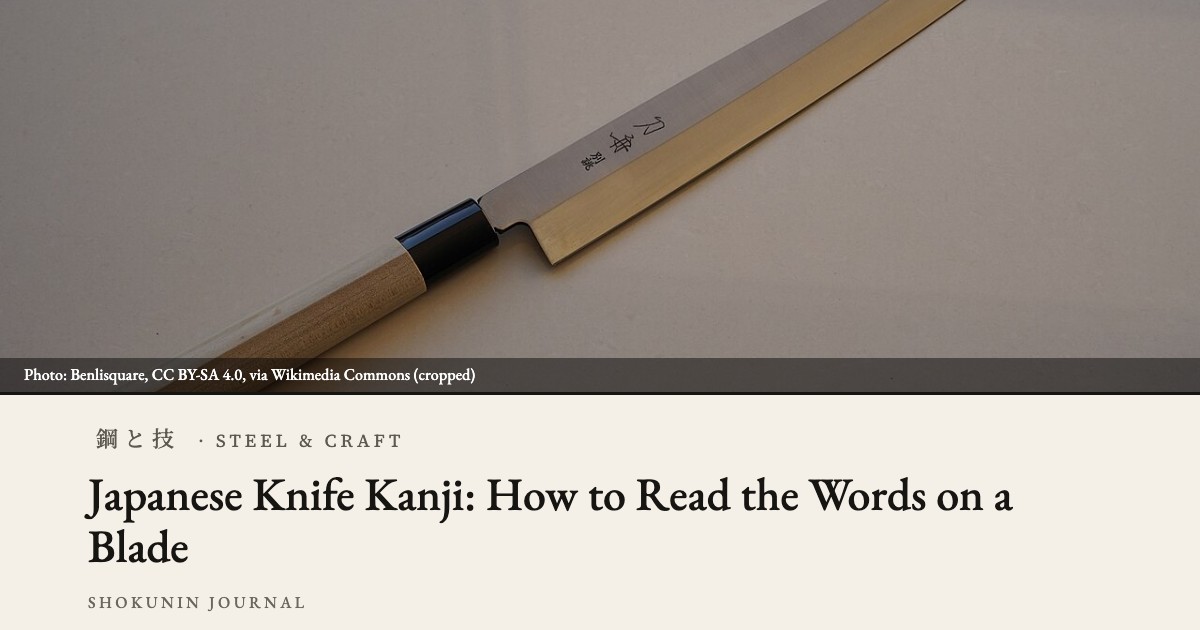
Many Japanese knives carry a few characters on the blade, the handle or the box. Most of them are ordinary words: the type of knife, the steel, how the blade is built, or a brand name. This page lists the words you are most likely to see, with the reading and the meaning given by the makers who use them. It cannot tell you who made a particular knife.
In short: the characters on a Japanese knife usually name the knife type, the steel, the construction or finish, a grade or line label, or a brand or place. Grade words such as 特製 mean different things at different makers, and a name or place alone does not prove who made a knife or where.
How to use this page
Each table gives the Japanese term, its reading in the Latin alphabet, the meaning, and the maker or official body whose page we took it from. Readings follow the maker’s own spelling where it publishes one. Otherwise we use standard Hepburn romanization without long-vowel marks, as in the rest of this site. Many words are written in more than one way, for example 黒打 and 黒打ち, so we list the common variants together.
Knife types
These words say what shape the knife is. They are often followed by 包丁 (hocho, knife). For more on the main shapes, see Gyuto vs Santoku and Nakiri vs Usuba vs Petty.
| Japanese | Reading | Meaning | Who uses the term |
|---|---|---|---|
| 包丁 / 庖丁 / 庖刀 | hocho | Kitchen knife. Tojiro and KAI write 包丁; Aritsugu writes 庖丁 and Masamoto Sohonten writes 庖刀. On a blade or box it usually follows the knife type, as in 出刃包丁. | Tojiro, Aritsugu, Masamoto Sohonten |
| 三徳 | santoku | Household all-purpose knife for meat, fish and vegetables (Tojiro). | Tojiro |
| 牛刀 | gyuto | The chef’s knife. Tojiro says the name came with the custom of eating beef in the Meiji era, and that it is not limited to meat. | Tojiro |
| ペティ | petty | Small knife shaped like a scaled-down gyuto, for peeling and cutting fruit (Tojiro). | Tojiro |
| 菜切 | nakiri | Double-bevel vegetable knife with a rectangular blade (Tojiro, KAI). | Tojiro, KAI |
| 文化 | bunka | Household knife that Tojiro describes as a gyuto shape with the tip cut off at an angle. Tojiro lists it as 文化・剣型. | Tojiro |
| 筋引 | sujihiki | Long double-bevel knife for dividing large cuts of meat; known abroad as a slicer or carving knife (Tojiro). | Tojiro, Misono |
| 骨スキ / ガラスキ | honesuki / garasuki | Knives for separating meat from bone. Tojiro says the shape is Japanese and single-bevel. | Tojiro, Misono |
| 出刃 | deba | Thick, heavy single-bevel knife for breaking down fish (Tojiro, KAI). | Tojiro, KAI |
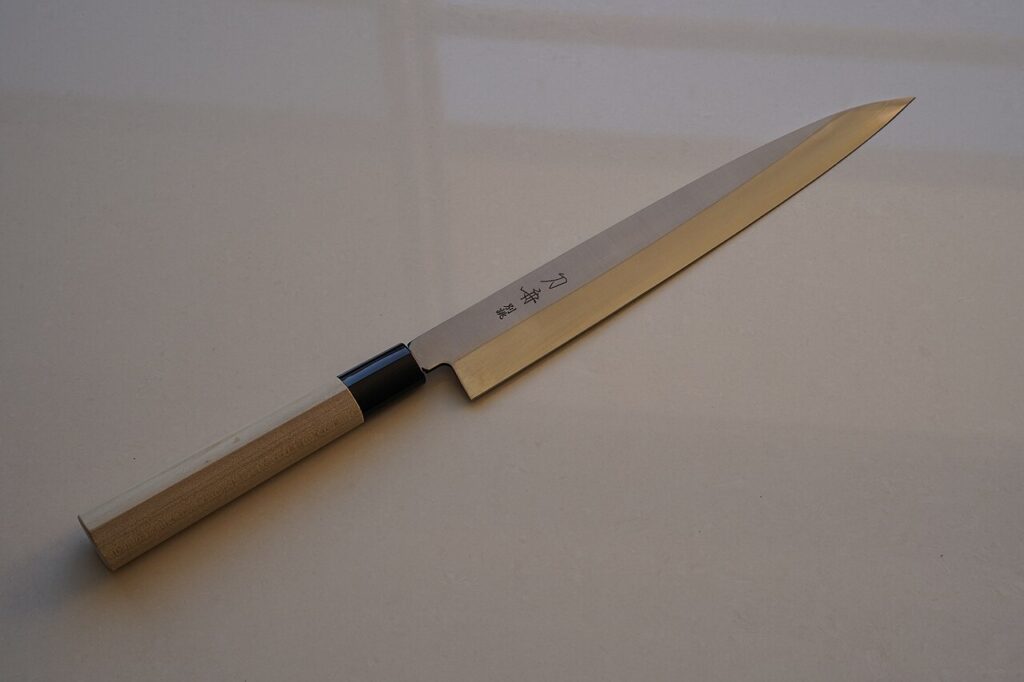
| 柳刃 | yanagiba | Kansai-style sashimi knife, used with one long pulling cut (Tojiro). | Tojiro, Aritsugu |
| 正夫 | shobu | Another name used for the sashimi knife. Tojiro says some people call a blade with a straighter edge line 正夫 (shobu) and one with a more rounded tip 柳刃. Sakai Takayuki’s Tokujo series lists 正夫 alongside ふぐ引 and 蛸引. | Tojiro, Sakai Takayuki |
| 刺身 | sashimi | Sashimi knife. KAI writes 刺身(柳刃)包丁, and Jikko lists 刺身 as a knife type. | KAI, Jikko |
| 蛸引 | takohiki | Kanto-style sashimi knife (KAI). | KAI, Tojiro |
| 薄刃 | usuba | Single-bevel vegetable knife (Tojiro). Note that KAI also uses 薄刃(菜切) for a thin double-bevel vegetable knife, so check the edge type. | Tojiro, KAI |
| 鎌型薄刃 / 鎌薄刃 | kamagata usuba / kama usuba | Kansai-style usuba; KAI says the tip is used for decorative cuts. KAI writes 鎌形薄刃 and Aritsugu’s product list writes 鎌薄刃. | Tojiro, KAI |
Steel words
These words name the blade steel. Several are short forms of steelmakers’ product names. Our guide to Japanese knife steels explains the steels themselves.
| Japanese | Reading | Meaning | Who uses the term |
|---|---|---|---|
| 鋼 / ハガネ | hagane | Carbon steel. Tojiro describes it as steel with 0.6% carbon or more under the JIS standard, used for Japanese-style knives; KAI defines steel more broadly as iron with 0.02–2.1% carbon. It rusts more easily than stainless steel. | Tojiro, KAI |
| 安来鋼 / ヤスキハガネ | Yasuki hagane | Proterial’s brand of steel (YSS Yasuki Hagane). KAI describes it as steel produced by Proterial, formerly Hitachi Metals, and graded into 黄紙, 白紙 and 青紙. Sakai Takayuki writes 安来 before the steel name, as in 安来白二鋼. | KAI, Tojiro, Proterial, Sakai Takayuki |
| 白紙 / 白紙1号・白紙2号 | Shirogami #1, #2 | Proterial’s Shirogami (“White paper”) carbon steel. Tojiro writes 白紙鋼 and gives the grades by carbon content. | Proterial, Proterial, Tojiro |
| 白一鋼・白二鋼・白三鋼 | shiro-ichi-ko, shiro-ni-ko, shiro-san-ko | Short forms used by Sakai makers. Sakai Ichimonji Mitsuhide writes 白二鋼(白紙2号). It also warns that one steelmaker has a grade called 白紙二号 and another has one called 白二, with very different composition standards, so the short form alone does not prove the steelmaker. | Sakai Ichimonji Mitsuhide, Sakai Takayuki |
| 青紙 / 青紙1号・青紙2号 | Aogami #1, #2 | Proterial’s Aogami (“Blue paper”) steel. Tojiro describes it as Shirogami #2 with chromium and tungsten added. | Proterial, Tojiro |
| 青一鋼・青二鋼 | ao-ichi-ko, ao-ni-ko | Short forms of Aogami #1 and #2. Sakai Ichimonji Mitsuhide writes 青二鋼(青紙2号); Sakai Takayuki’s Homura page gives the blade as 安来青二鋼 and describes it as 安来青紙2号. | Sakai Ichimonji Mitsuhide, Sakai Takayuki |
| 青紙スーパー | Aogami Super | The Aogami grade with the most carbon in Tojiro’s list (1.40–1.50%), made with added elements and special melting. | Tojiro, Jikko |
| 銀三 / 銀三鋼 | Ginsan | A stainless steel. Sakai Ichimonji Mitsuhide calls it a stainless steel close to Yasuki carbon steel; Sakai Takayuki writes 安来銀三鋼. Proterial itself writes the grade as GIN3. | Sakai Ichimonji Mitsuhide, Sakai Takayuki, Proterial |
| V金10号 | VG-10 (read “V-kin 10-go”) | Takefu Special Steel’s stainless steel VG-10. Tojiro writes V金10号(VG10); Takefu writes V金10(VG10). | Tojiro, Takefu Special Steel |
| 粉末ハイス / 粉末鋼 | funmatsu haisu / funmatsu-ko | Powder-metallurgy steel. Tojiro says the usual name 粉末ハイス鋼 comes from “high-speed steel”. Jikko lists SG2 under 粉末ハイス鋼, and Takefu calls its Super Gold 2 (SPG2) 粉末ステンレス・ハイス. | Tojiro, Jikko, Takefu Special Steel |
| ステンレス / ステンレス鋼 | sutenresu | Stainless steel: steel with chromium added so that it resists rust (Tojiro). | Tojiro |
| モリブデン鋼 / モリブデンバナジウム鋼 | moribuden-ko / moribuden banajiumu-ko | Molybdenum steel and molybdenum-vanadium steel. Tojiro describes the latter as stainless cutlery steel with molybdenum and vanadium added. Jikko and Masamoto Sohonten list モリブデン鋼 among their rust-resistant steels. | Tojiro, Jikko, Masamoto Sohonten |
| 特殊鋼 | tokushu-ko | “Special steel”. This is not one steel. Sakai Takayuki uses it for a rust-resistant soba knife whose blade it lists as stainless steel, and Sakai Ichimonji Mitsuhide uses it as a category that it says has the qualities of carbon steel but resists rust. It is also part of the company name 武生特殊鋼材 (Takefu Special Steel). | Sakai Takayuki, Sakai Ichimonji Mitsuhide, Takefu Special Steel |
Construction and finish words
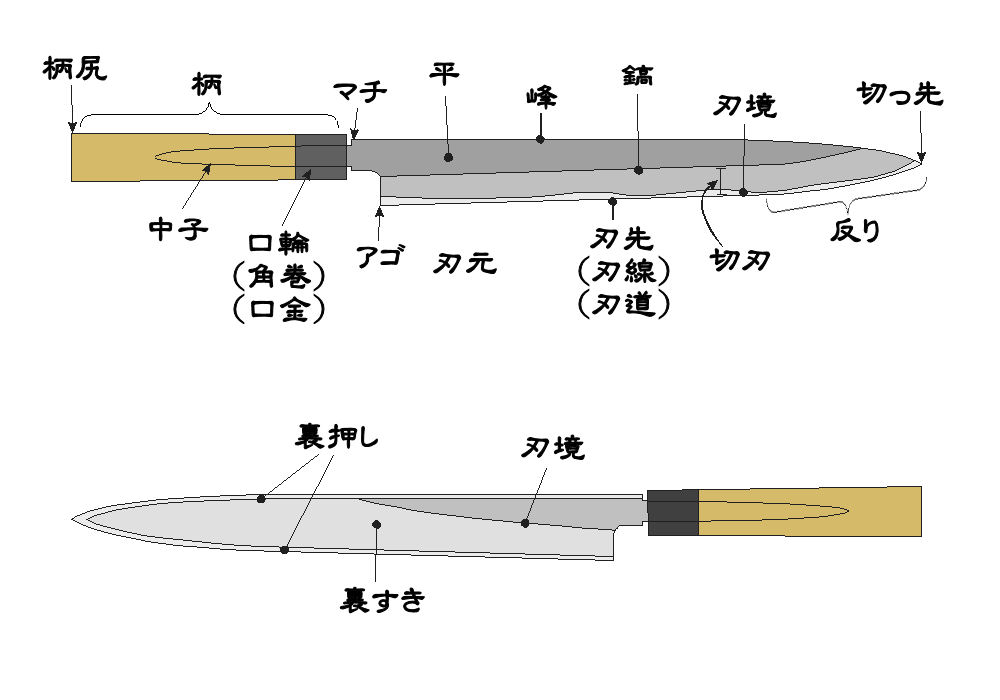
These words describe how the blade is built, how its surface is finished, or which hand it is ground for. Our guide to knife finishes covers the finishes in more detail.
| Japanese | Reading | Meaning | Who uses the term |
|---|---|---|---|
| 本焼 / 本焼き | honyaki | A blade made of a single steel and hardened differently along the blade. KAI gives the reading ほんやき. Tojiro says clay is applied before quenching, in a method similar to sword making. Sakai Takayuki also uses 水本焼 for its water-quenched honyaki. | KAI, Tojiro, Sakai Takayuki |
| 霞 / 霞研 / 本霞 | kasumi / kasumi-togi / hon-kasumi | Tojiro uses 霞 (合わせ) for a knife forged from soft iron and carbon steel, and says the name comes from the hazy look of the soft iron next to the bright steel. The labels vary by maker: Sakai Takayuki sells separate 霞研 (Kasumitogi) and 本霞研 (Honkasumi-togi) series, and Masamoto Sohonten uses 霞 and 本霞 as separate classes in its product codes. Neither page gives a shared definition of 本霞. | Tojiro, Sakai Takayuki, Sakai Takayuki, Masamoto Sohonten |
| 合わせ | awase | Two-layer construction: hard steel joined to soft iron, mostly on single-bevel Japanese knives (KAI). | KAI, Sakai Ichimonji Mitsuhide |
| 割込 / 割り込み | warikomi | Three-layer construction in which a hard metal is held between softer metal, mostly on double-bevel knives (KAI). Tojiro says clad knives are generally called 割込み包丁. | KAI, Tojiro |
| 三層 / 三層鋼 | sanso / sanso-ko | Three layers. KAI uses 三層鋼 for a hard metal held between two softer layers, and describes one of its series as ハガネ三層鋼, combining carbon steel with stainless steel. | KAI |
| 全鋼 | zenko | Made from a single steel rather than joined layers (Tojiro). | Tojiro |
| ダマスカス | Damascus | In modern knives, different metals layered so that a pattern appears on the blade (Tojiro). | Tojiro |
| 墨流し | suminagashi | Sakai Ichimonji Mitsuhide treats it as another name for Damascus, and its product pages describe it as a pattern made by layering and forging two metals. | Sakai Ichimonji Mitsuhide, Sakai Ichimonji Mitsuhide |
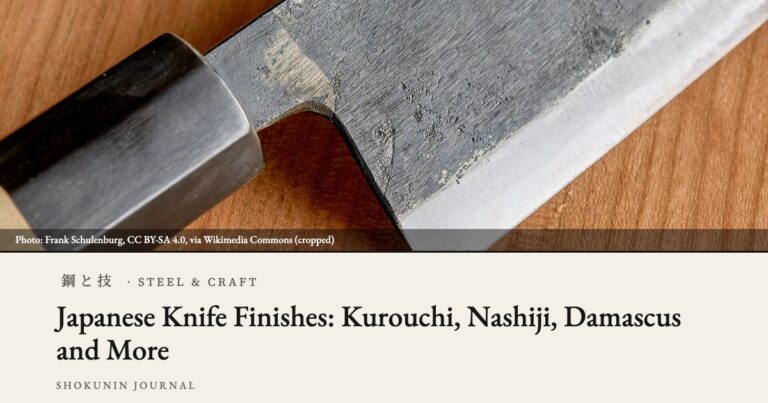
| 黒打 / 黒打ち | kurouchi | A blade left unpolished. Tojiro contrasts 黒打ち, where the polishing step is skipped, with polished blades. Masamoto Sohonten and Aritsugu use 黒打 in product names. | Tojiro, Masamoto Sohonten, Aritsugu |
| 磨き | migaki | Polished. Tojiro uses it as the opposite of 黒打ち; Sakai Takayuki uses it in product names. | Tojiro, Sakai Takayuki |
| 梨地 | nashiji | A surface finish. Sakai Ichimonji Mitsuhide uses the word for one of its nakiri knives but does not define it there. See our finishes guide. | Sakai Ichimonji Mitsuhide |
| 槌目 | tsuchime | Hammer-mark pattern. KAI describes 槌目加工 applied over the whole blade, and Sakai Takayuki describes a 槌目模様 on its 33-layer Damascus knives. | KAI, Sakai Takayuki |
| 鏡面 / 鏡面仕上 | kyomen / kyomen shiage | Mirror finish: Jikko describes it as polishing the blade face like a mirror. | Jikko, Masamoto Sohonten |
| 片刃 | kataba | Single-bevel: the edge is ground from one side only (Tojiro). | Tojiro, KAI |
| 両刃 / 諸刃 | ryoba / moroha | Double-bevel: the edge is ground from both sides (Tojiro). Masamoto Sohonten writes 諸刃, and lists one knife in both 諸刃 and 片刃 versions. | Tojiro, Masamoto Sohonten |
| 右利き / 左利き用 / 左用 | migikiki / hidarikiki-yo / hidari-yo | Right-handed / for left-handed use. Jikko says single-bevel knives come in right- and left-handed versions with the blade structure reversed. Aritsugu marks left-handed knives 左用. | Jikko, Tojiro, Aritsugu |
Words around a name
These words appear next to a brand or smith name. Several are grade or line labels. They have no fixed meaning across the industry: each maker uses its own, and most do not publish a definition. Read them as that maker’s label, not as a quality standard.
| Japanese | Reading | Meaning | Who uses the term |
|---|---|---|---|
| 銘 | mei | The name or mark put on the blade. Tojiro says it may be stamped, electro-etched, screen-printed or cut with a chisel. Sakai Takayuki’s product pages list it as a specification, for example 銘:堺孝行. | Tojiro, Sakai Takayuki |
| 作 | saku | In ordinary Japanese, “made by” or “work of” when it follows a name. It follows a name. Masahiro sells lines named 正広作, and Sakai Ichimonji Mitsuhide sells knives named 中川作 that it says are by the Sakai blacksmith 中川悟志 (Nakagawa). None of the makers we checked publishes a definition of the word. | Masahiro, Sakai Ichimonji Mitsuhide |
| 登録 / 登録商標 | toroku / toroku shohyo | Registered / registered trademark. The Japan Patent Office uses 登録商標 for a trademark registered under Japan’s trademark system. Masamoto Sohonten states that its mark is a registered trademark, and Sakai Takayuki lists some inscriptions as 登録 堺孝行. Aritsugu also uses 登録 as the name of a product line (see below). | Japan Patent Office, Masamoto Sohonten, Sakai Takayuki, Aoki Hamono Seisakusho |
| 特製 / 上製 | tokusei / josei | Line labels at Aritsugu, which lists yanagiba knives as 登録, 特製 and 上製. On the page we checked on October 7, 2026, a 27 cm 登録 was ¥36,850, a 特製 ¥47,300 and a 上製 ¥70,400, tax included; prices may change. The page does not explain the difference, and other makers may use these words differently. | Aritsugu |
| 特上 / 上作 / 別誂 | tokujo / josaku / betsu-atsurae | Labels at Sakai Takayuki. Its 特上 (Tokujo) series carries the inscription 堺孝行別誂, and its 本霞研 series carries 堺孝行上作. The pages give a star rank for each series but do not define the words. | Sakai Takayuki, Sakai Takayuki |
| 別作 / 別撰 / 最上 | bessaku / bessen / saijo | Labels at Masahiro. The company lists 正広別作 among its brands, and 最上, 特上 and 別撰 among its Japanese-style knife series. It does not define them on those pages. | Masahiro, Masahiro |
| 鍛造 / 本鍛造 | tanzo / hon-tanzo | Forged. Tojiro describes forged blades (打刃物) as steel and soft iron heated and hammered into shape. 本鍛造 is the name of a Tojiro series; the makers we checked do not publish a shared definition of it. | Tojiro, Tojiro |
| 手打ち | teuchi | Hand-hammered. Misono’s Japanese text says each blade is 手打ち鍛造, and its own English text says each blade is hammer-forged. | Misono |
| 打刃物 | uchihamono | Forged blades. It appears in the official names of the Traditional Crafts, such as 堺打刃物 (Sakai Uchihamono). | Association for the Promotion of Traditional Craft Industries, Tojiro |
| 日本製 | nihonsei | Made in Japan. Masahiro uses the word to say that its materials are sourced in Japan and that no processing is sent overseas. The words alone do not say which region or workshop. | Masahiro |
Place names
Place names appear in brand names and in the names of Japan’s officially designated Traditional Crafts. Our guide to knife regions covers each place.
| Japanese | Reading | Meaning | Who uses the term |
|---|---|---|---|
| 堺 | Sakai | Sakai, Osaka Prefecture. The Traditional Craft is 堺打刃物 (Sakai Uchihamono). | Association for the Promotion of Traditional Craft Industries, Tojiro |
| 関 | Seki | Seki, Gifu Prefecture. Seki City’s page for the Seki Kaji Denshokan museum describes exhibits of Seki swords and modern cutlery. | Seki City, Sakai Ichimonji Mitsuhide |
| 越前 | Echizen | Echizen, Fukui Prefecture. The Traditional Craft is 越前打刃物 (Echizen Uchihamono). | Association for the Promotion of Traditional Craft Industries, Tojiro |
| 武生 | Takefu | A name from the same area as Echizen. It appears in Takefu Knife Village (タケフナイフビレッジ), whose founders formed the 武生刃物工業研究会 in 1973 to discuss the future of Echizen Uchihamono, and in Takefu Special Steel (武生特殊鋼材), whose address is in Echizen City, Fukui. | Takefu Knife Village, Takefu Special Steel |
| 土佐 | Tosa | Kochi Prefecture. The Traditional Craft is 土佐打刃物 (Tosa Uchihamono). | Association for the Promotion of Traditional Craft Industries, Tojiro |
| 三条 / 越後三条 | Sanjo / Echigo Sanjo | Sanjo, Niigata Prefecture. The Traditional Craft is 越後三条打刃物 (Echigo Sanjo Uchihamono). | Association for the Promotion of Traditional Craft Industries, Sakai Ichimonji Mitsuhide |
| 燕三条 | Tsubame-Sanjo | Tsubame and Sanjo, Niigata Prefecture; Sakai Ichimonji Mitsuhide writes 燕・三条. Tojiro, based in Tsubame City, describes its knives as 燕三条製. | Tojiro, Sakai Ichimonji Mitsuhide |
| 播州三木 | Banshu Miki | Miki, Hyogo Prefecture. The Traditional Craft is 播州三木打刃物 (Banshu Miki Uchihamono). | Association for the Promotion of Traditional Craft Industries, Tojiro |
A place name in a brand does not prove where a knife was made. Sakai Ichimonji Mitsuhide, a brand that carries the name Sakai, says that it is very rare for every product of a place-named brand to be made in that place, and that knives sold in a producing region were not necessarily made there.
Maker and brand names
This short list includes only names for which the maker’s own official site shows both the Japanese writing and a Latin-alphabet spelling. The spelling is the maker’s own. It is not a complete list, and matching characters do not prove that a knife is genuine or who made it.
| Japanese | Maker’s spelling | Who it is | Official site |
|---|---|---|---|
| 藤次郎 | TOJIRO | Tojiro Co., Ltd., Tsubame City, Niigata. | Tojiro |
| 関孫六 | SEKIMAGOROKU | A KAI brand. KAI’s English brand site writes it as one word and says it carries on the craft and spirit of the swordsmith Seki no Magoroku. | KAI, KAI |
| 旬 | Shun | A KAI brand. | KAI, KAI |
| 正広 | MASAHIRO | Brands of Masahiro Co., Ltd. (株式会社マサヒロ), Seki, Gifu. The company lists both 正広 and MASAHIRO. | Masahiro |
| 實光 | Jikko | Jikko (實光刃物), Sakai, Osaka. The site gives the reading じっこう. | Jikko |
| 堺一文字光秀 | Sakai Ichimonji Mitsuhide | Brand of Ichimonji Chuki (一文字厨器株式会社), Osaka. | Sakai Ichimonji Mitsuhide, Sakai Ichimonji Mitsuhide |
| 有次 | Aritsugu | Aritsugu Co., Ltd., Kyoto. | Aritsugu |
| 正本総本店 | Masamoto Sohonten | Masamoto Sohonten Co., Ltd. Its site warns of similar and imitation products and asks buyers to specify 正本総本店製. | Masamoto Sohonten, Masamoto Sohonten |
| 堺孝行 | Sakai Takayuki | Brand of Aoki Hamono Seisakusho (青木刃物製作所), Sakai, Osaka. | Aoki Hamono Seisakusho, Aoki Hamono Seisakusho |
| 菊一文字 | Kikuichimonji | Kikuichimonji, Kyoto. Its Japanese site shows 菊一文字 and links to its English site, which uses KIKUICHIMONJI. | Kikuichimonji, Kikuichimonji |
| ミソノ | Misono | Misono Cutlery Co., Ltd. (ミソノ刃物株式会社), Seki, Gifu. | Misono |
What the characters cannot tell you
- Who made the blade. A brand name is not always the name of the workshop that forged or sharpened the knife. Sakai Ichimonji Mitsuhide, for example, sells knives made by a named blacksmith under its own brand. Masamoto Sohonten, for example, warns buyers about similar and imitation products.
- Which steelmaker supplied the steel. Sakai Ichimonji Mitsuhide notes that the short form 白二 is used for steels from more than one steelmaker, with different composition standards. See our steels guide.
- Where the knife was made. A place name in a brand is not proof of origin. See our regions guide.
- How good the knife is. Grade words are each maker’s own labels. The same word can sit at a different level in another maker’s range.
- Whether the marking is original. Tojiro says a name may be stamped, etched, printed or chiselled, and Tojiro says it also engraves personal names, so characters on a blade may be a personal name and not a brand.
How to ask a maker or seller
- If you know where the knife was bought, ask that seller first. They can check their own records and catalogues.
- If the characters match a maker listed above, use the contact page on that maker’s official site. Ask whether the marking is one they use; do not assume it is.
- Send clear, well-lit photos of both sides of the blade, the handle and any box or paperwork, and give the blade length in millimetres.
- Copy the characters exactly as they appear, or send the photo, and do not rely on a translation app’s reading of a brand name.
- Expect that some makers will not be able to confirm an old or second-hand knife. We cannot identify knives either.
Sources
- Tojiro: Japanese knife shapes (Japanese)
- Aritsugu: yanagiba knives (Japanese)
- Masamoto Sohonten: product code system (Japanese)
- Tojiro: Western knife shapes (Japanese)
- KAI: Japanese-style knives (Japanese)
- Sakai Ichimonji Mitsuhide: global site
- Sakai Takayuki: Tokujo series (Japanese)
- Jikko: carbon steels (Japanese)
- Tojiro: knife materials (Japanese)
- KAI: hagane knives (Japanese)
- Proterial: December 9, 2025 press release (Japanese)
- Proterial: Shirogami 1 data
- Sakai Ichimonji Mitsuhide: carbon steel knives (Japanese)
- Sakai Takayuki: Homura series (Japanese)
- Sakai Ichimonji Mitsuhide: Ginsan steel (Japanese)
- Sakai Takayuki: Chef wa-bocho, Ginsan (Japanese)
- Takefu Special Steel: V-Gold 10 (Japanese)
- Jikko: stainless steels (Japanese)
- Takefu Special Steel: Super Gold 2 (Japanese)
- Sakai Takayuki: Tokushu-ko V-kin 1 soba knife (Japanese)
- Tojiro: honyaki and kasumi (Japanese)
- Sakai Takayuki: Honyaki series (Japanese)
- Sakai Takayuki: Kasumitogi series (Japanese)
- Sakai Takayuki: Honkasumi-togi series (Japanese)
- Sakai Ichimonji Mitsuhide: structure of single-bevel knives (Japanese)
- Tojiro: Damascus steel (Japanese)
- Sakai Ichimonji Mitsuhide: Damascus (Japanese)
- Sakai Ichimonji Mitsuhide: Nakagawa-saku suminagashi product page (Japanese)
- Aritsugu: kurouchi knives (Japanese)
- Sakai Takayuki: Shiro-ni-ko migaki soba knife (Japanese)
- Sakai Ichimonji Mitsuhide: nakiri knives (Japanese)
- KAI: what is a santoku? (Japanese)
- Sakai Takayuki: 33-layer Damascus (Japanese)
- Jikko: mirror finish (Japanese)
- Tojiro: edge direction and handedness (Japanese)
- Jikko: left-handed knives (Japanese)
- Aritsugu: left-handed knives (Japanese)
- Tojiro: how stamped knives are made (Japanese)
- Masahiro: products (Japanese)
- Sakai Ichimonji Mitsuhide: Nakagawa-saku honyaki announcement (Japanese)
- Japan Patent Office: outline of the trademark system (Japanese)
- Masamoto Sohonten: Japanese knives (Japanese)
- Sakai Takayuki: Nihonko series (Japanese)
- Aoki Hamono Seisakusho: company profile (Japanese)
- Masahiro: company profile (Japanese)
- Tojiro: knife history and culture (Japanese)
- Tojiro: Hon-tanzo series announcement (Japanese)
- Misono: Sweden steel series
- Association for the Promotion of Traditional Craft Industries: Sakai Uchihamono (Japanese)
- Masahiro: about (Japanese)
- Seki City: Seki Kaji Denshokan (Japanese)
- Sakai Ichimonji Mitsuhide: knife-making regions (Japanese)
- Association for the Promotion of Traditional Craft Industries: Echizen Uchihamono (Japanese)
- Takefu Knife Village: our story (Japanese)
- Association for the Promotion of Traditional Craft Industries: Tosa Uchihamono (Japanese)
- Association for the Promotion of Traditional Craft Industries: Echigo Sanjo Uchihamono (Japanese)
- Tojiro: company information (Japanese)
- Association for the Promotion of Traditional Craft Industries: Banshu Miki Uchihamono (Japanese)
- KAI: SEKIMAGOROKU brand site
- KAI: Seki Magoroku history (Japanese)
- KAI: Shun brand site (Japanese)
- KAI: about Shun (Japanese)
- Jikko: official site (Japanese)
- Aritsugu: about (Japanese)
- Masamoto Sohonten: English site
- Aoki Hamono Seisakusho: Sakai Takayuki official site (Japanese)
- Kikuichimonji: Japanese site
- Kikuichimonji: English site
- Misono: official site
We check facts against the sources above, as described in our Editorial & Accuracy Policy. If you spot an error, please tell us through our contact form.


3 Comments
Comments are closed.