How to Choose Your First Japanese Kitchen Knife: A Checklist
Researched. This checklist is based on buying guides published by Japanese knife makers and retailers (Tojiro, KAI, Global, Jikko and Sakai Ichimonji Mitsuhide), checked on October 3, 2026. It recommends no specific products and contains no affiliate links.
A first Japanese knife is easier to choose if you settle a few questions before you look at any listing. Here are the decisions, with what the makers say about each.
The checklist
- Type: santoku, or a gyuto if you cook Western-style or cut large ingredients
- Length: about 165–180 mm (6.5–7.1 in) for a santoku, 180–210 mm (7.1–8.3 in) for a gyuto
- Steel: stainless unless you are willing to dry the knife after every use
- Edge: double-bevel
- Handle: Western (riveted) or Japanese (wa) — a care decision as much as a feel decision
- Fit: hold it if you can; check weight and balance
- The listing: it should name the steel, the maker, the blade length and the bevel
1. Which type
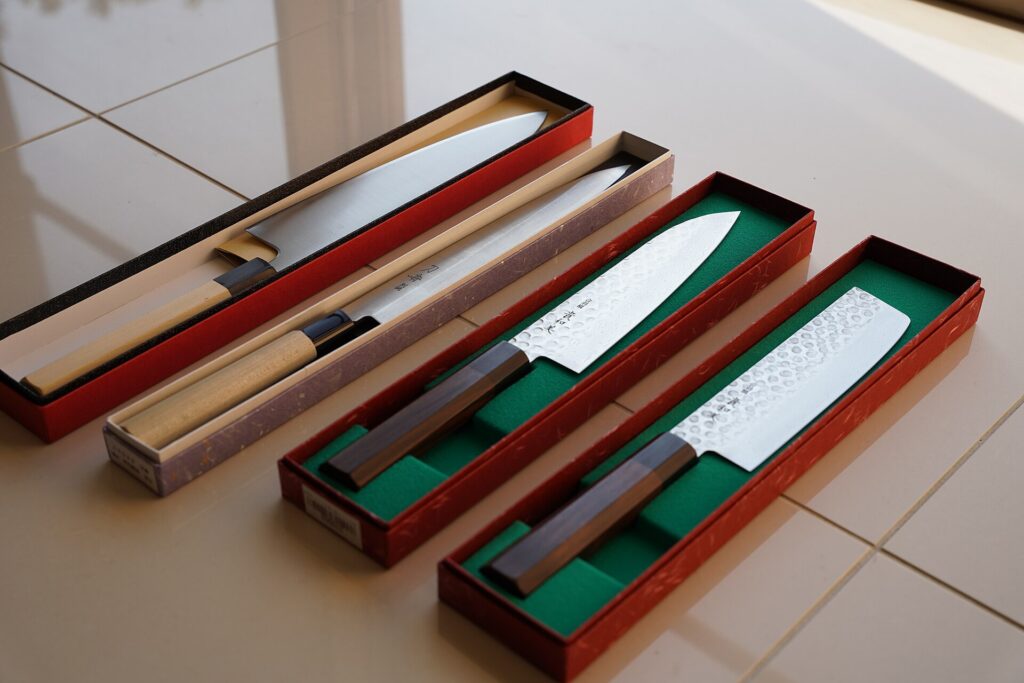
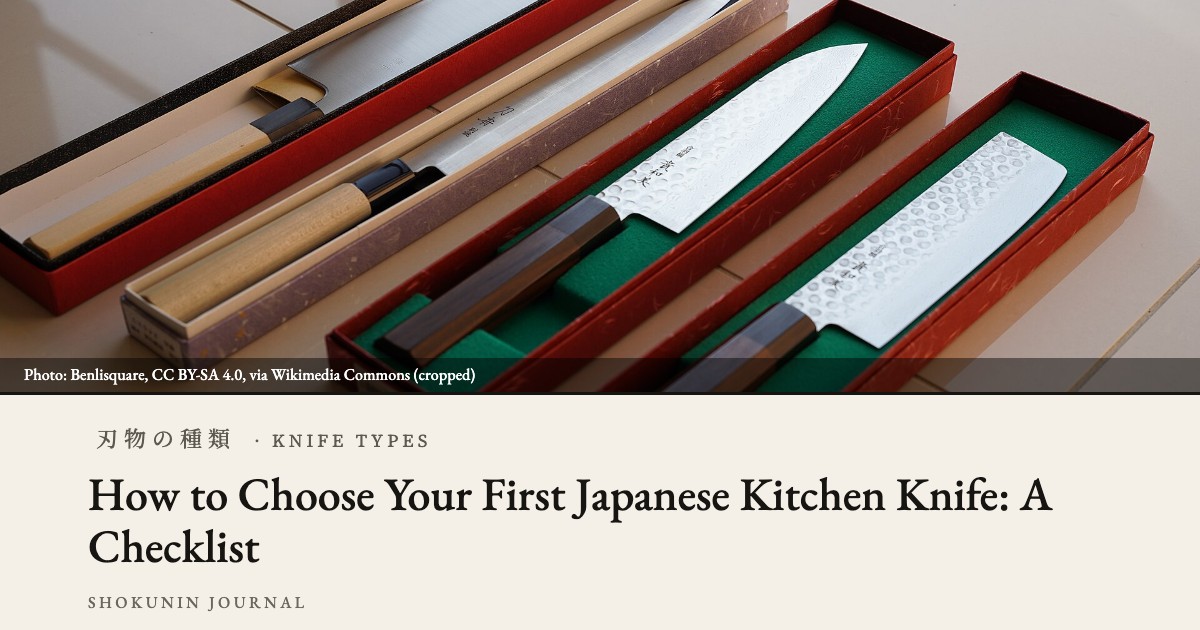
Makers agree that the santoku is the default first knife. Tojiro says that if you are unsure, choose a santoku, and Jikko calls it the basic all-purpose knife for home use. Sakai Ichimonji Mitsuhide recommends it for people buying their first knife, noting that its nearly straight edge keeps more of the blade on the board, so vegetables are cut through cleanly.
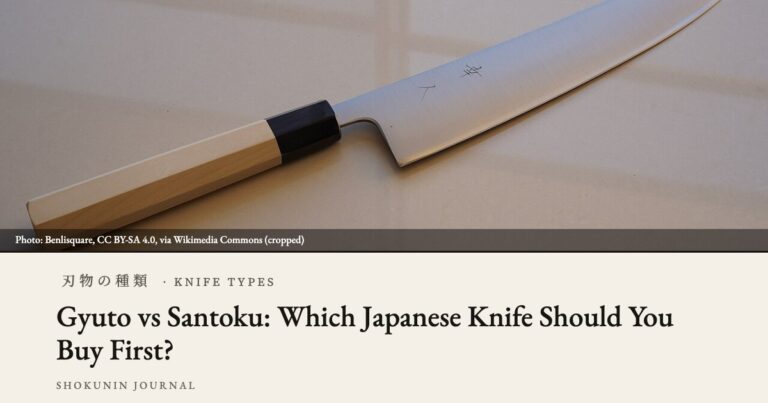
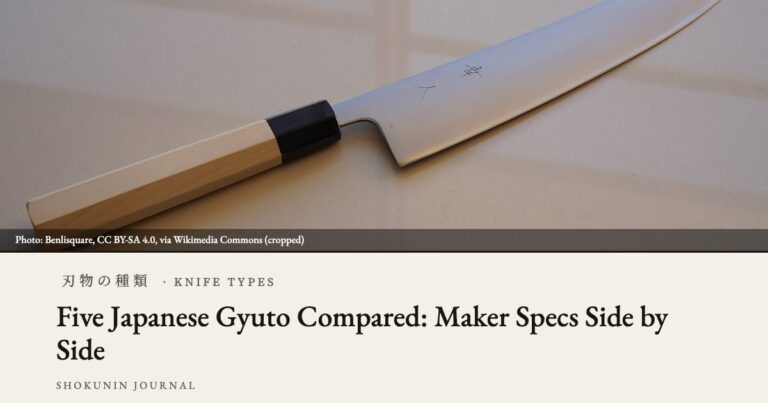
The gyuto is the alternative. Tojiro suggests it for cooks who want a wider range of cutting techniques, and notes that its narrower blade keeps fatty meat and fish from sticking, while the pointed tip helps with fine work. Our Gyuto vs Santoku guide goes into the differences.
2. Which length
- Santoku: Jikko and Sakai Ichimonji Mitsuhide center on 165–180 mm (6.5–7.1 in), and Tojiro leans toward 180 mm (7.1 in) for home use. KAI says 150–200 mm (5.9–7.9 in) is the mainstream range and suggests 160 mm (6.3 in) or more if you cook often or cut large ingredients. KAI also suggests a shorter blade if your counter or board is small, and offers a 145 mm (5.7 in) knife aimed at small hands.
- Gyuto: Tojiro and Jikko suggest 210 mm (8.3 in) for home use. Sakai Ichimonji Mitsuhide puts home gyuto at 180–210 mm (180 mm (7.1 in) is popular; its English guide suggests 210 mm (8.3 in)) and professional sizes at 210–240 mm (8.3–9.4 in).
Two useful rules from makers: Global suggests a blade 2–3 cm (0.79–1.2 in) longer than the ingredients you cut most, and Tojiro says that “bigger is better” does not really apply, so choose what you can control comfortably.
3. Which steel
Every maker we checked frames this as a maintenance trade-off rather than a right answer.
- Stainless: rust-resistant and easy to care for. Global says it is the most common choice for home kitchens. Sakai Ichimonji Mitsuhide and Jikko note that stainless can be harder to sharpen than carbon steel.
- Carbon steel (hagane): Tojiro and KAI describe it as sharper but needing daily care, and KAI says it rusts if left wet.
- Clad (layered) blades: Tojiro describes three-layer construction as combining sharpness with rust resistance. Tojiro recommends its own VG-10 series to people buying their first gyuto.
Our guide to Japanese knife steels explains the common names you will see.
4. Which edge
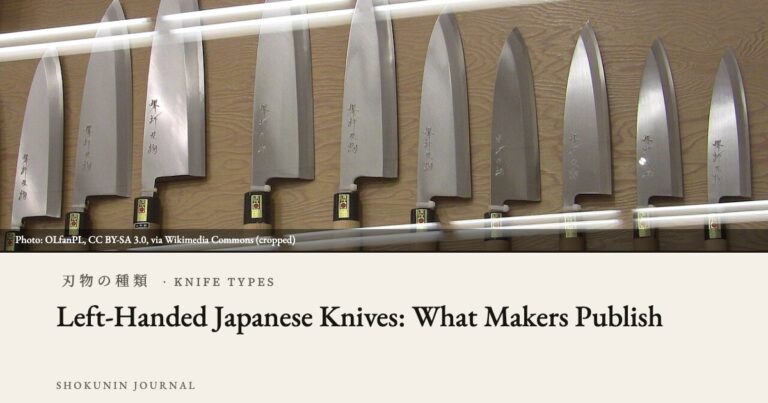
Most santoku and gyuto are double-bevel, sharpened on both sides. Jikko and Sakai Ichimonji Mitsuhide note that double-bevel knives can be used by right- and left-handed cooks alike. Jikko adds that its Western-style gyuto and petty knives are edged for right-handers, and Sakai Ichimonji Mitsuhide says right- and left-handed users can use a double-bevel knife in almost the same way once it has been sharpened once. Single-bevel knives come in separate right- and left-handed versions. Jikko says left-handed versions, and double-bevel knives edged for left-handers, cost about 1.5 times as much. For a first knife, a double-bevel blade avoids that complication and matches the techniques most home cooks already use.
5. Which handle
- Western (yo) handle: Tojiro describes the full-tang, three-rivet construction as the most durable. It warns that cheaper spine-tang (se-toshi) handles can leave a gap that lets water in and rusts the tang.
- Japanese (wa) handle: a wooden handle the blade is fitted into. Jikko says wa handles wear out before the blade does, and can be replaced; it quotes replacement from ¥2,200. Sakai Ichimonji Mitsuhide’s English guide says wa handles allow different grips but take a little practice.
- All-stainless: KAI notes it is hygienic but can be slippery when wet.
6. Check the fit
Tojiro suggests checking, in the shop, the weight, the size for your hands and kitchen, and the handle feel. Sakai Ichimonji Mitsuhide says the balance point should be near the heel of the blade, and warns against handles weighted for looks, which make the knife feel like a seesaw. It also notes that handles on knives aimed at overseas buyers are often made larger than those for the Japanese market, so hold one before assuming it fits.
7. Read the listing
This is our own checklist, not a maker’s. A trustworthy listing should state:
- The steel by name (for example VG-10, Shirogami #2), not just “Japanese steel”
- The maker or brand
- The blade length in mm
- Whether the blade is double- or single-bevel
- Where the knife is made
Vague listings are a warning sign. Takefu Special Steel, the maker of VG-10, warns that imitation products are sold online with claims of using its steel, and says their performance and quality differ greatly. If a listing names a steel, it should also name who made the knife.
Before you cut anything
Tojiro says not to cut frozen food with a santoku or gyuto, and to buy a knife designed for it instead. Korin asks customers not to cut extremely hard items such as bones and seeds. Tojiro advises against the dishwasher; KAI notes that some of its models are dishwasher-safe, so check your product. Our knife care guide has the details.
Related: our guide to where to buy Japanese knives outside Japan, and five santoku compared by maker specifications.
See also: what makers publish about left-handed knives, five gyuto compared by maker specifications, and our 2026 Japanese knife gift guide.
Sources
- Tojiro: how to choose a knife (Japanese)
- Tojiro: knife types and uses (Japanese)
- Tojiro: choosing a gyuto (Japanese)
- Tojiro: handle construction (Japanese)
- KAI: choosing a kitchen knife (Japanese)
- KAI: what is a santoku? (Japanese)
- Global (Yoshikin): how to choose, part 1 (Japanese)
- Global (Yoshikin): how to choose, part 2 (Japanese)
- Jikko: knife types buying guide (Japanese)
- Jikko: choosing a size (Japanese)
- Jikko: right- and left-handed knives (Japanese)
- Jikko: replacing a handle (Japanese)
- Sakai Ichimonji Mitsuhide: home kitchen knives (Japanese)
- Sakai Ichimonji Mitsuhide: gyuto (Japanese)
- Sakai Ichimonji Mitsuhide: santoku vs gyuto (Japanese)
- Sakai Ichimonji Mitsuhide: choosing by handle (Japanese)
- Sakai Ichimonji Mitsuhide: how to choose (English)
- Korin: Japanese knife FAQ
- Takefu Special Steel: VG-10 (Japanese)
We check facts against the sources above, as described in our Editorial & Accuracy Policy. If you spot an error, please tell us through our contact form.