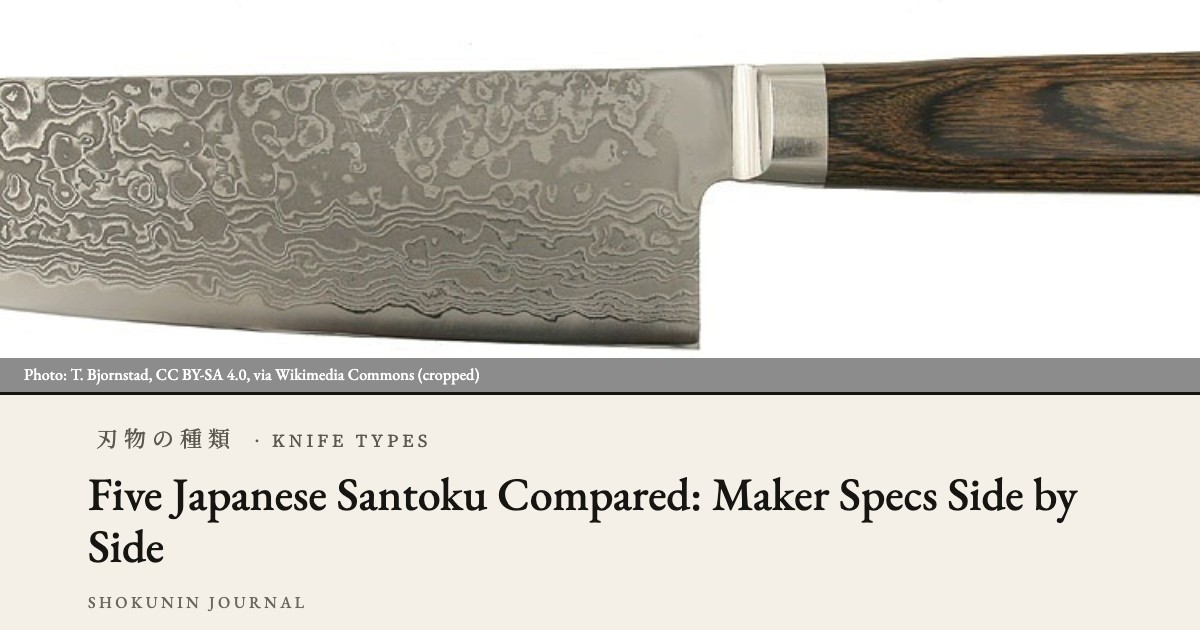
Five Japanese Santoku Compared: Maker Specs Side by Side
Researched. Every figure below was read on the maker’s own website on October 4, 2026. We have not used or handled these knives, and we do not recommend one over another. Where a maker does not publish a figure, the table says “not stated”. Prices are the makers’ tax-inclusive prices in Japan on that date; prices abroad differ. This article contains no affiliate links.
A santoku is the knife most Japanese makers suggest as a first knife (see our first-knife checklist). Once you know you want one, the next question is which, and that is where the maker’s specification sheet matters more than any review. This article puts five makers’ published specifications side by side, in their own words, so you can compare what they actually claim.
In short: Tojiro and Yaxell name VG-10, Masahiro names its own MBS-26 steel, and KAI and Global name no grade. Only Masahiro states a hardness (HRC 58–59), listed weights run from about 150 g to about 190 g, and only the Tojiro F-503 and Global G-46 are sold abroad under the same codes.
Which knives, and why these
We chose one mid-range stainless or clad santoku of 165–180 mm (6.5–7.1 in) from each of five makers whose official websites publish specifications: Tojiro (Niigata), KAI (Gifu), Global by Yoshikin (Niigata), Masahiro (Gifu) and Yaxell (Gifu). We wanted to include Misono, but its official site lists model numbers and blade lengths only, with no weights, prices or other specifications, so there was not enough to compare.
The knives are not equivalent in price or purpose: Masahiro lists its MV-S in its commercial-use (gyomu-yo) series, while Yaxell pitches its knife as easy to handle at home, for professionals and home cooks alike. We note this in the table rather than leaving it out.
The specifications, side by side
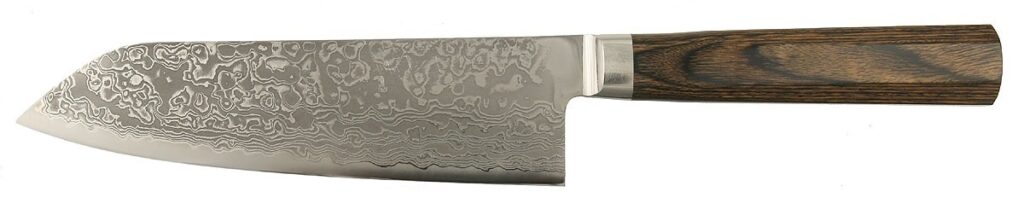
| Tojiro CLASSIC Santoku 170 mm (F-503) | KAI Seki Magoroku Damascus Santoku 165 mm (AE5200) | Global G-46 Santoku 18 cm (7.1 in) | Masahiro MV-S Santoku 175 mm (No. 13623) | Yaxell Kaneyoshi-saku VG10 Santoku | |
|---|---|---|---|---|---|
| Blade length | about 170 mm (6.7 in) | 165 mm (6.5 in) | 18 cm (7.1 in) | 175 mm (6.9 in) | 16.5 cm (6.5 in) |
| Overall length | about 295 mm (11.6 in) | 293 mm (11.5 in) | 31 cm (12.2 in) | not stated | not stated |
| Weight | about 190 g | 158 g in the spec table; about 161 g in the same page’s comparison chart | 175 g | about 150 g | not stated |
| Blade thickness | not stated | 2 mm (0.08 in) | not stated | 2.0 mm (0.08 in) | not stated |
| Blade steel, as stated | Core VG-10, clad with 13-chrome stainless steel | Stainless clad: “high-carbon stainless cutlery steel” edge, stainless sides (steel grade not named) | “Stainless steel for cutlery (with molybdenum and vanadium)” | Masahiro’s own stainless steel MBS-26: 0.9% carbon, 13% chromium, molybdenum, vanadium | Three-layer steel, VG10 core |
| Hardness | not stated | not stated | not stated | HRC 58–59 | not stated |
| Handle | Laminated reinforced material, with bolster | Laminated reinforced wood, integral welded bolster | 18-8 stainless steel | Antibacterial stainless steel, integral bolster | Laminated reinforced wood (black), SUS410 rivets |
| Edge | Double-bevel, right- or left-handed | Right- or left-handed (the store page says the knife can be used by left-handers) | Double-bevel, right- or left-handed | not stated | not stated |
| Dishwasher | not stated | Not dishwasher-safe, per the comparison chart on the store page | not stated | not stated | not stated |
| Country of manufacture, as stated on the product page | not stated on the product page (the shop’s site title describes its knives as Tsubame-Sanjo-made) | Japan | not stated | not stated (the company is in Seki, Gifu) | Japan |
| Maker’s price (tax included, Japan, Oct 4, 2026) | ¥13,200 | ¥16,500 | ¥12,100 | ¥22,550 | ¥8,580 (listed as awaiting stock) |
| Maker’s own description of who it is for | “Ideal for use in an ordinary home”; also claims professional-level sharpness with easy care | Described as a premium line that “also meets professional needs” | “Chosen for home use and as a gift”; the 18 cm (7.1 in) length suits large items such as whole cabbage | Listed in Masahiro’s commercial-use series; the page says it “draws out the subtle skills of professionals” | “A high-performance knife that is easy to handle at home”; also “for professionals and home cooks alike” |
What the table shows
- The steel is often not named. Only Tojiro and Yaxell name a steel grade (VG-10/VG10). KAI’s page for the Damascus santoku describes the edge steel only as high-carbon stainless cutlery steel, and Global’s page says stainless cutlery steel with molybdenum and vanadium. Masahiro names its own alloy, MBS-26, and gives its composition. If a retailer’s listing names a grade the maker does not, ask where that figure comes from.
- Hardness is rarely published. Masahiro is the only one of the five to state a Rockwell hardness (HRC 58–59). Treat hardness figures you see elsewhere for the other four as the seller’s claim, not the maker’s.
- Weights differ by 40 g. Masahiro’s 175 mm (6.9 in) knife is listed at about 150 g, Tojiro’s 170 mm (6.7 in) knife at about 190 g. Global notes that dimensions and weight vary slightly between individual knives.
- Construction differs. Tojiro, KAI and Yaxell describe clad or layered blades with a different steel at the core; Global and Masahiro describe a single stainless steel. Our steel guide explains what that means for sharpening.
- Dishwashers: only KAI’s page addresses this, and it marks the Damascus santoku as not dishwasher-safe. Follow the care instructions that come with the knife; our care guide collects what the makers say in general.
Notes on each maker’s page
- Tojiro sells the F-503 under the name “Tojiro CLASSIC”, which its series page describes as its long-selling clad (warikomi) line, used “from homes to professional cooks”. The product page notes a 1996 Good Design Long Life Design award.
- KAI says the integral bolster is welded to the blade so that moisture and rust cannot get in, and that the handle is laminated reinforced wood. The store page’s spec table does not name the edge steel beyond “high-carbon stainless cutlery steel”.
- Global sells the G-46 as its 18 cm (7.1 in) santoku and says on the product page that the longer blade suits large ingredients. It also warns not to cut frozen food, pumpkin, corn, dried mochi, bones or shells with it.
- Masahiro lists the MV-S santoku in its commercial-use series, with sub-zero treatment and an antibacterial stainless handle.
- Yaxell says its Kaneyoshi-saku blades pass an in-house sharpness test of cutting more than 100 sheets of paper, and that the knife is sub-zero treated.
Can you buy these outside Japan?
This matters more than the specs if you live abroad, so we checked the makers’ own international pages on October 4, 2026.
- Tojiro: the F-503 appears under the same code and the same “TOJIRO CLASSIC” name on Tojiro’s English site, which lists authorized distributors for Japan and overseas and warns that some sellers on amazon.com are unauthorized and may sell counterfeits. Tojiro’s Japanese online shop lists shipping rates for Japan only.
- Global: the G-46 is listed under the same code on Yoshikin’s English site. Yoshikin’s FAQ says it does not do international shipping and asks overseas customers to buy through a local store.
- KAI: KAI Europe sells a “Sekimagoroku” range, but its series (Kaname, Composite, Ensei, Shoso and others) do not include the Damascus series sold in Japan, and KAI USA’s sites list Shun and Kai Housewares rather than Seki Magoroku. Treat the AE5200 as a Japan-market model unless a KAI site in your country lists it.
- Masahiro: its website is Japanese only, with a dealer list covering Japan. We found no official overseas distributor information.
- Yaxell: the Kaneyoshi-saku line is in the Japanese “own brands” section; Yaxell’s English page shows different export series (Super Gou, Ran, Zen, Ketu, Taishi) and a contact form, with no distributor list.
In short, two of the five (Tojiro F-503 and Global G-46) are sold abroad under the same codes; the other three are, as far as the makers’ sites show, Japanese-market models you would buy in Japan or through an importer. See our guide to buying a kitchen knife in Japan for carrying one home.
How to use this
If you are choosing between knives like these, decide first on handle material and weight, then on whether you want a named steel. Then check the maker’s page yourself before buying: specifications change, and the pages we read are linked below. We will update this table when we find a change; the date at the top is the date we last checked.
Related: Shun vs Seki Magoroku explains KAI’s two brands, and our guide to where to buy Japanese knives outside Japan covers what each maker says about overseas sales. For the same makers’ chef’s knives, see five gyuto compared by maker specifications.
Sources
- Tojiro: CLASSIC Santoku 170 mm, F-503 (Japanese)
- Tojiro: CLASSIC series page (Japanese)
- KAI store: Seki Magoroku Damascus Santoku 165 mm, AE5200 (Japanese)
- Global (Yoshikin): G-46 Santoku 18 cm (Japanese)
- Masahiro: MV-S Santoku 175 mm, No. 13623 (Japanese)
- Yaxell: Kaneyoshi-saku VG10 Santoku (Japanese)
- Misono: UX10 santoku listing (Japanese)
- Tojiro Japan (English): TOJIRO CLASSIC series
- Tojiro Japan (English): distributors information
- Tojiro online shop: shipping costs (Japanese)
- Yoshikin (English): GLOBAL products
- Yoshikin (English): FAQ
- KAI Europe (English)
- KAI USA
- Masahiro: dealers (Japanese)
- Yaxell (English)
We check facts against the sources above, as described in our Editorial & Accuracy Policy. If you spot an error, please tell us through our contact form.

2 Comments
Comments are closed.