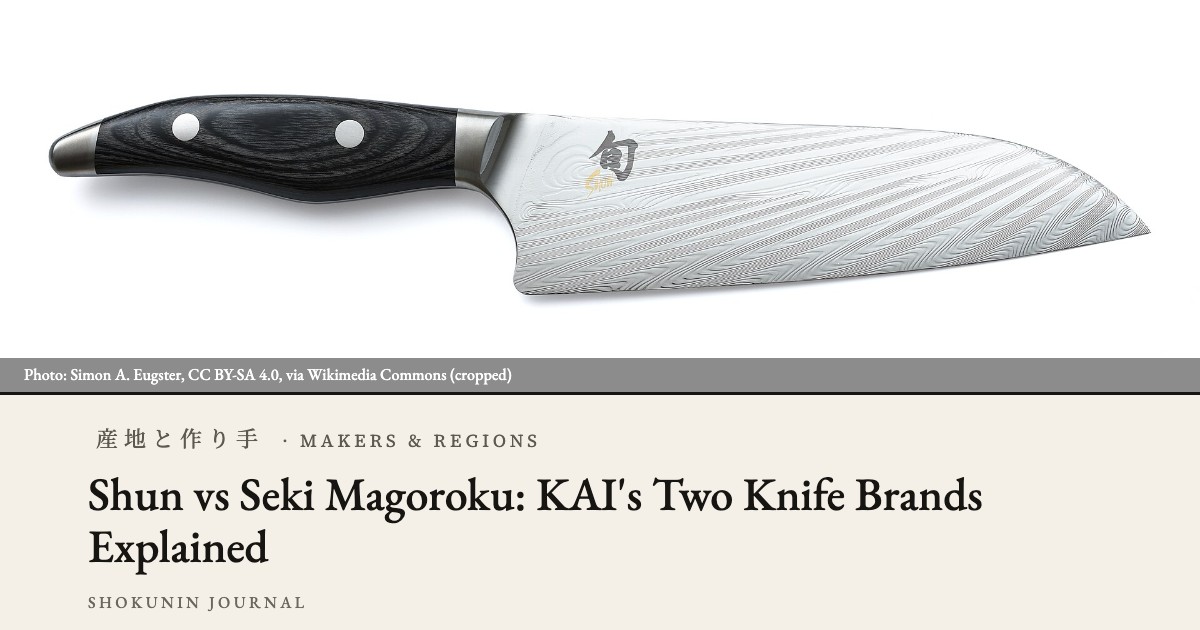
Shun vs Seki Magoroku: KAI’s Two Knife Brands Explained
Researched. This article is based only on KAI’s own websites in Japan, the US and Europe, checked on October 4, 2026 and rechecked on October 7, 2026. We have not tested Shun or Seki Magoroku knives for this article and recommend neither. This article contains no affiliate links.
If you shop for Japanese knives in the US or Europe you will see Shun everywhere. If you shop in Japan you will see Seki Magoroku everywhere. Both are brands of the same company, KAI, and both are made in Japan. Here is how KAI itself describes them.
One company, founded in Seki
KAI’s corporate timeline says the company was founded in 1908 when Saijiro Endo began making folding knives; Kai USA’s history page adds that he set up shop in Seki City, Gifu Prefecture. KAI Corporation is now headquartered in Tokyo; its manufacturing arm, KAI Industries, is based in Seki and lists factories in Seki (Oyana, Senbiki and Tahara) and Gujo. KAI set up its US company in Portland, Oregon in 1977 and its European company in Solingen, Germany in 1980.
Seki Magoroku: KAI’s main brand in Japan
KAI’s English brand page calls Seki Magoroku “the Kai’s flagship brand” (the Japanese page says main brand), covering kitchen knives, cooking tools and grooming products. The name comes from the swordsmith Magoroku Kanemoto II, known as “Seki no Magoroku” because he lived in Seki; KAI says his motto, “unbreakable, unbending, and cut well”, is carried on in the brand name.
The Japanese lineup runs from an entry series (Wakatake) through stainless and carbon-steel series to a “Master Line”. KAI Europe sells a Seki Magoroku range in Europe, but with different series from Japan: Kaname, Composite, Ensei, Shoso, KK Yanagiba, Kinju & Hekiju and Migaki. Kai USA’s Shun site lists no Seki Magoroku knife series; it carries only a Seki Magoroku peeler.
Shun: made for overseas, mostly sold in the US
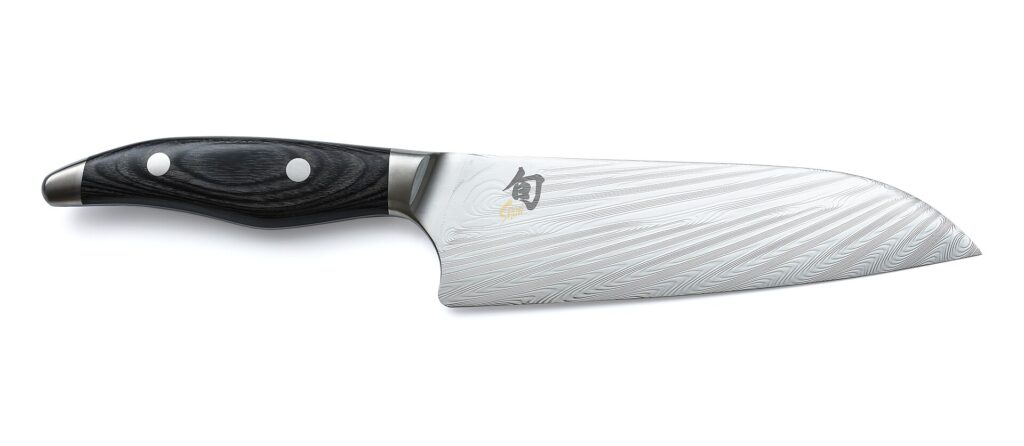
KAI’s Japanese Shun page is unusually direct about who the brand is for. It says Shun began sales in Europe and North America in 2000, is now sold in more than 60 countries, and was originally planned as a product for overseas markets; about 90% of its sales are abroad, with the US the largest market. KAI adds that it has sold some Shun products in Japan since 2009. Kai USA’s history page says Shun was introduced to the North American market in 2002.
The name, according to Kai USA, refers to the Japanese idea of the moment when food is at its seasonal best. Kai USA says every Shun knife is handcrafted in Seki City and takes at least 100 steps to complete. KAI’s corporate timeline says cumulative Shun shipments had reached 10 million knives as of October 2022.
How the knives are built, in KAI’s words
We compare one well-known series from each brand. These are KAI’s published descriptions, not test results.
| Shun Classic (Kai USA page) | Seki Magoroku Damascus (KAI Japan page) | |
|---|---|---|
| Core steel | “Proprietary VG-MAX cutting core”; KAI USA says VG-MAX builds on the VG10 formula and is proprietary to Shun | “High-carbon stainless cutlery steel” (grade not named) |
| Cladding | 34 layers of stainless Damascus each side (68 total); the spec table says “69 layer Damascus” | 32 layers of different stainless steels |
| Edge | 16° each side | Right- or left-handed; the store page says left-handers can use it |
| Handle | D-shaped ebony-finished Pakkawood | Laminated reinforced wood, no rivets, welded bolster |
| Country of origin | Japan (“Handcrafted in Seki City, Japan”) | Japan |
| Price example | not compared (US pricing) | Santoku 165 mm (6.5 in): ¥16,500 tax included |
KAI’s Japanese page for the Shun Classic santoku describes the blade only as a stainless composite with a “special stainless cutlery steel” core; the name VG-MAX appears on the US site, not the Japanese one.
Warranty and sharpening: the biggest practical difference
- Kai USA (Shun): a limited warranty for the lifetime of the original owner, and a free sharpening service for as long as you own the knife, with the customer paying a return shipping and processing fee ($15 in the US, $25 for Canada and Mexico, per the warranty page when we checked). Kai USA accepts warranty and sharpening requests only for products bought in the USA, Canada or Mexico, and will not honor products bought from unauthorized sources. Kai USA’s warranty page lists in-person drop-off at its Tualatin, Oregon headquarters on weekdays, but the same page also carries a notice that walk-in service is closed, so check before you go.
- KAI Japan: a paid re-sharpening service by its in-house “knife meisters”: ¥2,500 (tax included, shipping both ways free) per Western- or Japanese-style knife that fits within A4 size; bread knives and Chinese cleavers ¥4,000; knives larger than A4 size ¥3,300 (bread knives and Chinese cleavers ¥5,500) plus your own shipping to KAI; about three knives per order; for KAI products only. We found no lifetime-warranty statement on the KAI Japan pages we checked.
What this means if you are choosing
- Buying Shun from Kai USA or an authorized dealer in the US, Canada or Mexico gets you Kai USA’s warranty and free sharpening; under Kai USA’s own terms, products bought elsewhere are not covered.
- Seki Magoroku series differ between Japan and Europe, so a model name from a Japanese review may not exist in your market. Check KAI’s site for your country.
- Both brands state Japan as the country of origin on the product pages we checked.
Related: our guide to buying Japanese knives outside Japan and five santoku compared, which includes the Seki Magoroku Damascus santoku.
Sources
- KAI: Seki Magoroku brand, about (Japanese)
- KAI: Seki Magoroku brand, about (English)
- KAI: Seki Magoroku knife series (Japanese)
- KAI: Seki Magoroku Damascus series (Japanese)
- KAI store: Seki Magoroku Damascus santoku 165 mm (Japanese)
- KAI: Shun brand, about (Japanese)
- KAI: Shun Classic santoku 180 mm, DM0702 (Japanese)
- KAI: re-sharpening service (Japanese)
- KAI Group: company profile (English)
- KAI Group: company profile (Japanese)
- KAI Group: history (English)
- Kai USA (Shun): about us
- Kai USA (Shun): history
- Kai USA (Shun): Classic 8-inch chef’s knife
- Kai USA (Shun): blade steels
- Kai USA (Shun): warranty
- Kai USA (Shun): sharpening Q&A
- KAI Europe (English)
We check facts against the sources above, as described in our Editorial & Accuracy Policy. If you spot an error, please tell us through our contact form.


One Comment
Comments are closed.