Left-Handed Japanese Knives: What Makers Publish
Researched. This guide is based on information published by Japanese knife makers and retailers (Jikko, Sakai Ichimonji Mitsuhide, Tojiro, KAI, Shun, Global, MAC, Korin, Kama-Asa and Aritsugu), checked on October 7, 2026. We have not tested specific knives for this article. This article contains no affiliate links.
If you are left-handed, the questions to settle before buying a Japanese knife are whether the edge, and the handle, were made with a right hand in mind. This article collects what makers and established shops publish on that point. It reports their statements only; we have not handled or compared the knives.
In short: Tojiro and Global say their double-bevel knives can be used with either hand, while Jikko, Kama-Asa and Korin describe some double-bevel edges as ground for right-handers. Single-bevel knives such as the deba and yanagiba are made in separate left-handed versions, which Jikko prices at about 1.5 times the right-handed price.
At a glance
| Maker or shop | Double-bevel knives | Left-handed single-bevel | Handle note | Source |
|---|---|---|---|---|
| Jikko | Double-bevel knives can be used with either hand; Western-style gyuto and petty are edged for right-handers, and a left-handed edge costs 1.5 times the price | Yes: left-handed deba and sashimi (yanagiba) categories; about 1.5 times the right-handed price | Chestnut-shaped wa handles must be fitted on the opposite side; tell the shop when ordering | 1, 2 |
| Sakai Ichimonji Mitsuhide | Used almost the same way by either hand after one sharpening; a slightly left-biased edge can be put on for a sharpening fee | Yes: says to choose the left-handed version; takes custom orders | Chestnut and D-shaped handles are optimised for right-handed users | 1, 2, 3 |
| Tojiro | All double-bevel knives it currently sells are for both hands | Where one exists, it is shown in the product name and page; some are made to order | ORIGAMI series: handle shape may feel awkward for left-handers | 1, 2 |
| KAI (Japan) | Most nakiri are double-bevel and usable with either hand; some products are marked for both right- and left-handed use | Yes: left-handed Seki Magoroku deba knives in its online store | Sells left-handed-only Shun Classic (L) models with a D-shaped handle | 1, 2, 3, 4 |
| Shun (Kai USA) | Not stated | Not stated | Classic D-shaped handle was designed for right-handed users; says many left-handers find it works for them | 1 |
| Global (Yoshikin) | Double-bevel knives such as santoku and gyuto can be used with either hand | Yes: IST-05L (small deba), IST-06L (yanagiba), IST-07L (deba) | Not stated | 1 |
| MAC | Not stated | Yes: Japanese Series yanagiba sold in right- and left-handed versions | Not stated | 1, 2 |
| Korin (retailer) | Most common edge in its Western-style collection is about 70:30 for right-handed users; many models can be re-ground for left-handed use | Left-handed knives must be specially ordered | Not stated | 1, 2, 3 |
| Kama-Asa (retailer) | Its amane gyuto is ground 7:3 (front to back) for right-handers; separate left-handed versions are listed | Yes: left-handed deba, yanagiba and usuba are listed | Not stated | 1, 2, 3 |
| Aritsugu | Not stated | Product page lists a category named 左庖丁 (literally, left knives) | Not stated | 1 |
| Misono | Not stated | Not stated | Not stated | 1 |
| Masamoto Sohonten | Not stated | Not stated | Not stated | 1 |
| Kamata Hakensha | Not stated | Not stated | Not stated | 1 |
“Not stated” means we found no statement on the pages listed under Sources. It does not mean the maker has no left-handed products. Prices and availability are as shown on October 7, 2026 and can change.
Double-bevel knives
A double-bevel knife is sharpened on both sides. Most santoku, gyuto and petty knives are double-bevel. Makers describe them in two different ways.
Makers that say either hand can use them:
- Tojiro says the edge is symmetrical, so its double-bevel knives can be used by right- and left-handed cooks, and that every double-bevel knife it currently sells is for both hands. It adds one caveat: the ORIGAMI series is also for both hands, but its handle shape may feel awkward to left-handed users.
- Global says double-bevel knives such as the santoku and gyuto can be used regardless of the dominant hand.
- KAI says most nakiri are double-bevel and can be used by right- and left-handed people. In its santoku article, several products carry a note that the knife is for both right- and left-handed use.
- Sakai Ichimonji Mitsuhide’s FAQ says most Western-style knives such as the gyuto and santoku are double-bevel, apart from some exceptions, and can be used by either hand.
Makers and shops that describe a right-handed edge:
- Jikko says double-bevel knives can be used by either hand, and that the santoku is basically double-bevel. It also says Western-style gyuto and petty knives, although generally double-bevel, are edged for right-handers, and that making one left-handed costs 1.5 times the price.
- Kama-Asa says the edge of its amane gyuto is ground at a ratio of 7 on the front to 3 on the back, an angle it describes as easier for right-handers to use. It lists separate left-handed versions of the amane gyuto, santoku and sujihiki. On the day we checked, the 240 mm (9.4 in) amane gyuto was listed at ¥29,700 in both the standard and the left-handed version.
- Korin’s knife catalog says the most common edge shape in its collection of Western-style knives is “in the range of 70:30 for right-handed users”. The same catalog describes one series, Suisin Special Inox, as sharpened close to center and usable in both right and left hands.
- Sakai Ichimonji Mitsuhide says that with double-bevel knives, right- and left-handed users can use them in almost the same way once the knife has been sharpened once.
Our first Japanese knife checklist covers the other decisions for a first double-bevel knife.
Single-bevel knives: deba, yanagiba, usuba
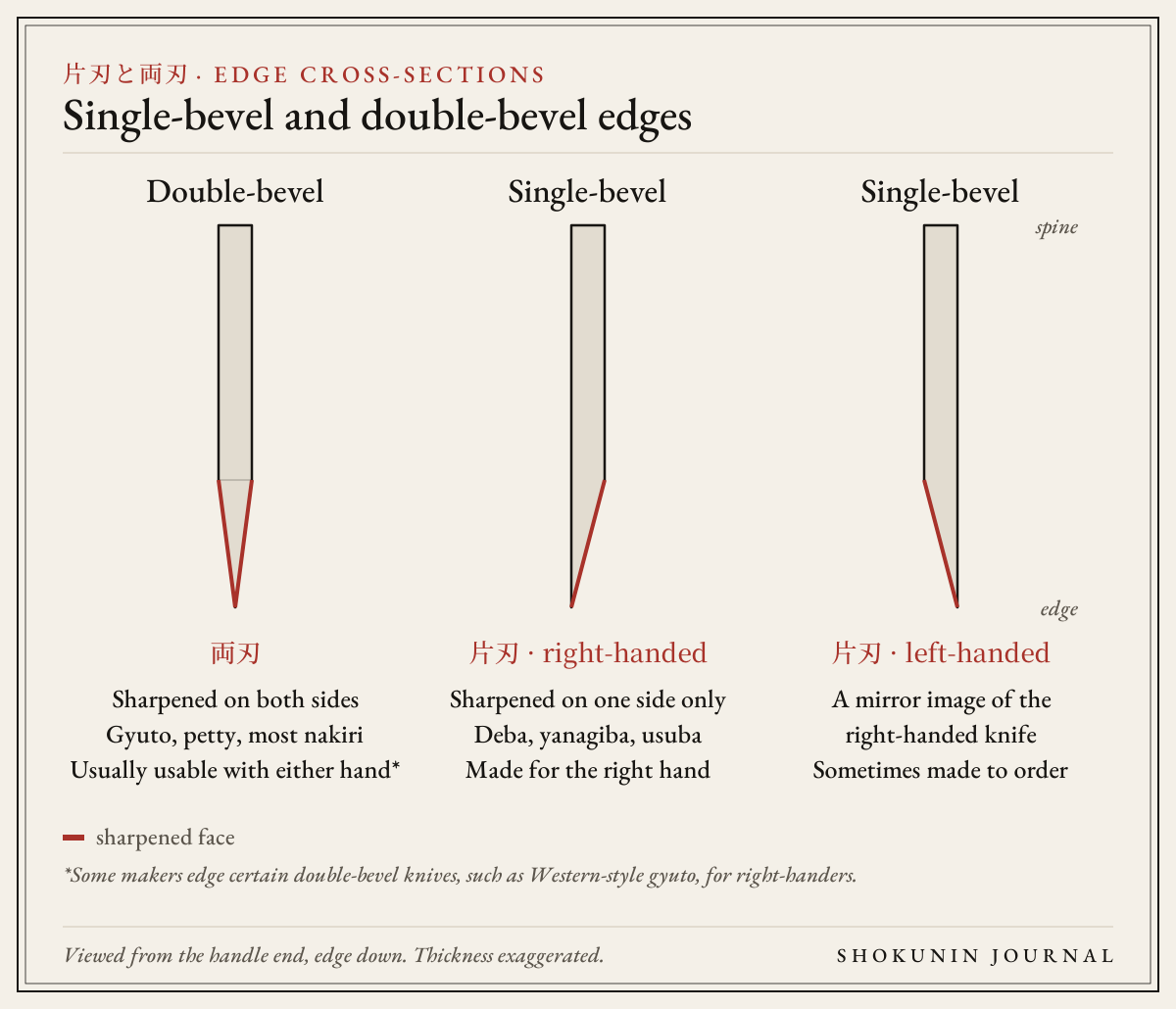
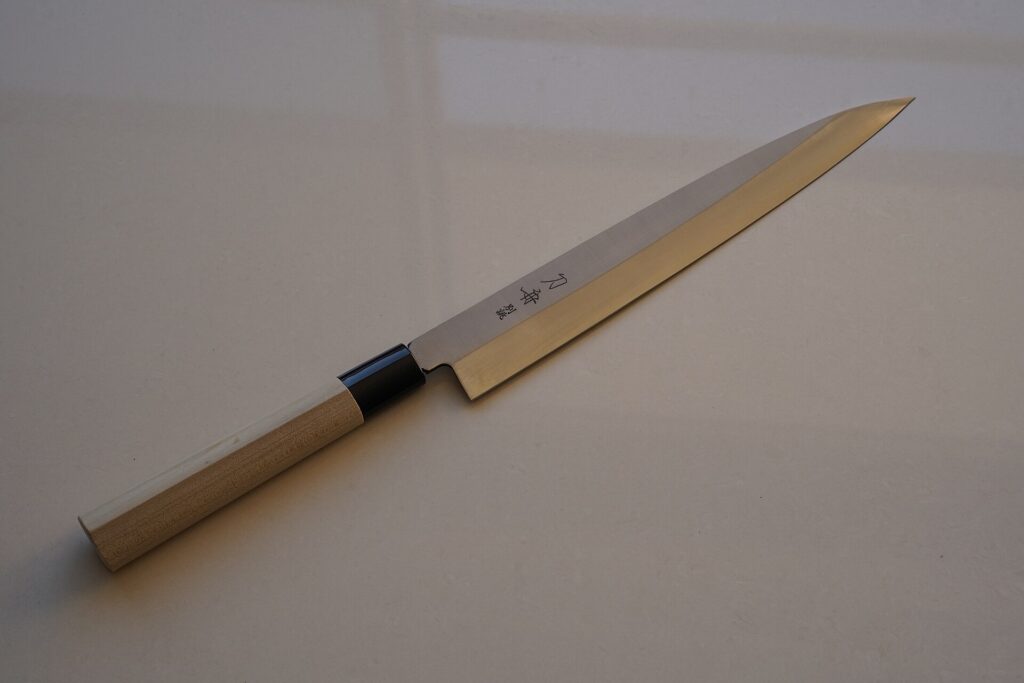
A single-bevel knife is sharpened on one side only. Jikko says the blade structure of a left-handed single-bevel knife is completely reversed, and that a right-handed one cannot be used in the left hand. Sakai Ichimonji Mitsuhide and Tojiro likewise say single-bevel knives are divided into right- and left-handed versions. Our nakiri, usuba and petty guide explains where the single-bevel usuba fits.
What makers publish about left-handed versions and their cost:
- Jikko: lists left-handed deba and sashimi (yanagiba) knives. It says a left-handed single-bevel knife costs 1.5 times the right-handed price. Its explanation is that craftsmen normally make right-handed knives, so a left-handed one takes two to three times as long, and it sets the price at about 1.5 times.
- KAI: its online store lists left-handed Seki Magoroku knives. The Ginju ST deba 150 mm (5.9 in) was listed at ¥7,150 including tax in the left-handed version and ¥6,050 in the standard version.
- MAC: its US site sells the Japanese Series yanagiba in right- and left-handed versions. The 11½ in (about 292 mm) FKW-10 was listed at US$250 right-handed and US$300 left-handed.
- Global: lists left-handed single-bevel models IST-05L (small deba), IST-06L (yanagiba) and IST-07L (deba) alongside the right-handed IST-05, IST-06 and IST-07.
- Tojiro: says that where a left-handed product exists, it is shown in the product name and on the product page. Its English FAQ says some left-handed products are made to order.
- Sakai Ichimonji Mitsuhide: tells left-handed customers to choose the left-handed version of single-bevel knives. Its English site says it keeps a left-handed selection in its Osaka store and takes custom orders.
- Korin: its catalog repeats the note “Left-handed knives must be specially ordered” on its knife pages. A product page for one of its yanagi says left-handed blades are special ordered from Japan, cost more than right-handed ones and need additional time.
- Kama-Asa: lists left-handed deba, yanagiba and azumagata (東型) usuba.
- Aritsugu: its product page includes a category named 左庖丁 (literally, left knives). We found no further detail on that page.
Handles
An edge is not the only part that can be handed.
- D-shaped handles: Shun’s FAQ says the D-shape of the Shun Classic handle “was designed to tuck into the palm of a right-handed user”, and adds that many left-handers find the handle works just as well for them. It suggests holding the knife before buying. In Japan, KAI’s online store lists Shun Classic (L) models, including a 200 mm (7.9 in) chef’s knife with a D-shaped handle, with the note that they are for left-handed use only.
- Chestnut-shaped wa handles: Jikko says that some Japanese-style knives have a chestnut-shaped handle, which must be fitted on the opposite side for a left-handed user, and asks customers to say so when ordering. Sakai Ichimonji Mitsuhide’s English site says chestnut and D-shaped handles are optimised with right-handed users in mind.
- Symmetrical handles: Jikko says many handles on double-bevel household knives are symmetrical, so left-handed users can hold them comfortably. In KAI’s santoku article, one product description (a Shun Kaji knife) says the knife has a symmetrical design that left-handed people can use.
We found no maker statement on the pages listed that describes octagonal handles specifically as ambidextrous.
Re-grinding an edge for left-handed use
- Korin: its catalog says many of its Western-style models “can be re-ground for left-handed use by Korin’s resident knife master for a minimal charge”, and refers readers to its price list. For traditional single-bevel knives, Korin’s FAQ says the structure of the knife makes conversion impossible.
- Sakai Ichimonji Mitsuhide: says that for a sharpening fee it can put an edge biased slightly to the left on a double-bevel knife from the start. It notes that this leaves sharpening marks.
- Jikko: says making a Western-style gyuto or petty left-handed costs 1.5 times the price.
None of these pages states a fee in yen or dollars (Jikko gives a multiplier and Korin refers to its price list), so ask the shop before ordering.
Serrated and bread knives
We found no statement about left-handed use of serrated or bread knives on the pages listed. Global’s FAQ and MAC’s FAQ both mention serrated edges, but only in relation to what they are and to sharpening.
What we could not find
We found no statement about left-handed use in the text of the pages we checked for Misono, Masamoto Sohonten and Kamata Hakensha. Parts of those sites present product information as images or catalogs, which we did not rely on. If you are considering one of these makers, ask the maker or the retailer directly.
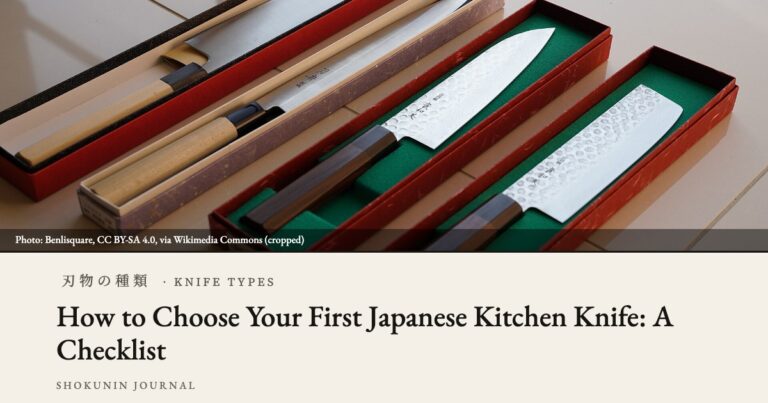
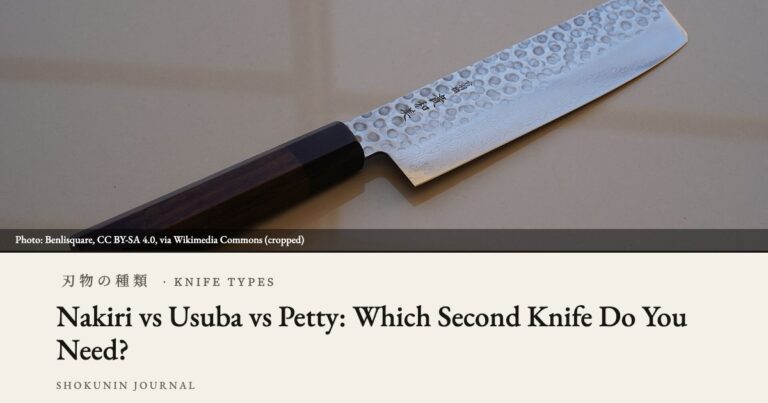
Related: How to Choose Your First Japanese Kitchen Knife and Nakiri vs Usuba vs Petty.
Sources
- Jikko: right- and left-handed knives (Japanese)
- Jikko: left-handed knives (Japanese)
- Sakai Ichimonji Mitsuhide: FAQ (Japanese)
- Sakai Ichimonji Mitsuhide: home kitchen knives (Japanese)
- Sakai Ichimonji Mitsuhide: left-handed knives (English)
- Tojiro: FAQ (Japanese)
- Tojiro: FAQ (English)
- KAI: what is a nakiri? (Japanese)
- KAI: what is a santoku? (Japanese)
- KAI online store: Seki Magoroku Ginju ST deba 150 mm, left-handed (Japanese)
- KAI online store: Seki Magoroku Ginju ST deba 150 mm (Japanese)
- KAI online store: Shun Classic chef’s knife 200 mm (L) (Japanese)
- Shun (Kai USA): FAQ
- Global (Yoshikin): FAQ (Japanese)
- MAC: Japanese Series 11½ in yanagiba (FKW-10)
- MAC: FAQ
- Korin: knife catalog (PDF)
- Korin: Japanese knife FAQ
- Korin: Shiro-ko Hongasumi yanagi product page
- Kama-Asa: amane gyuto (Japanese)
- Kama-Asa: amane gyuto, left-handed (Japanese)
- Kama-Asa: search results for left-handed knives (Japanese)
- Aritsugu: products (Japanese)
- Misono: site map and series pages (Japanese)
- Masamoto Sohonten: website (Japanese)
- Kamata Hakensha: FAQ (Japanese)
We check facts against the sources above, as described in our Editorial & Accuracy Policy. If you spot an error, please tell us through our contact form.


2 Comments
Comments are closed.