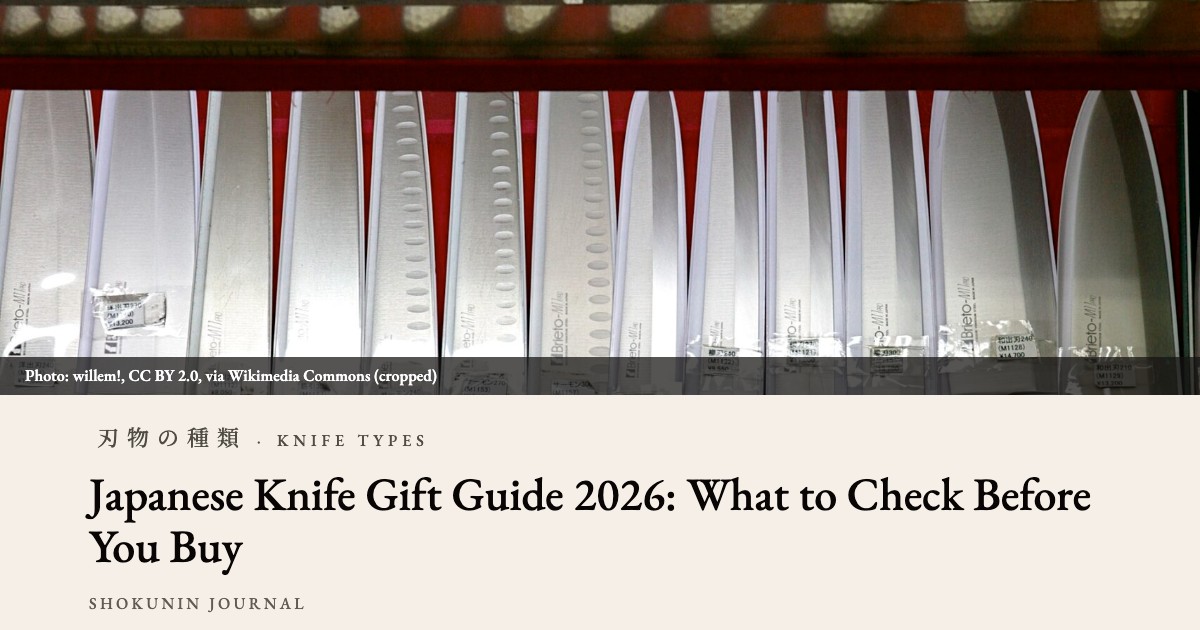
Japanese Knife Gift Guide 2026: What to Check Before You Buy
Researched. This guide brings together facts from our earlier articles, which are based on Japanese makers’ and retailers’ websites (each article gives its own check date and sources), and the U.S. Postal Service’s 2026 holiday shipping page, checked November 1, 2026. We have not tested the knives listed here, and we do not rank them. This article contains no affiliate links.
If you are thinking of giving a Japanese kitchen knife, a few questions about the person come before any brand: what they cook, which hand they use, and whether they will dry a blade after washing it. This guide goes through those questions in order, then lists the knives from Japanese makers that we have already compared from published specifications.
In short: start with the shape (the makers and retailers we checked suggest a santoku for home cooking and vegetables, and a gyuto for larger food); note that carbon steels such as Shirogami and Aogami can rust and need drying after use; and check whether the edge suits a left-handed cook. For delivery by December 25 within the lower 48 states, USPS recommends sending by December 17 with Ground Advantage, December 18 with Priority Mail and December 19 with Priority Mail Express.
1. Pick the shape
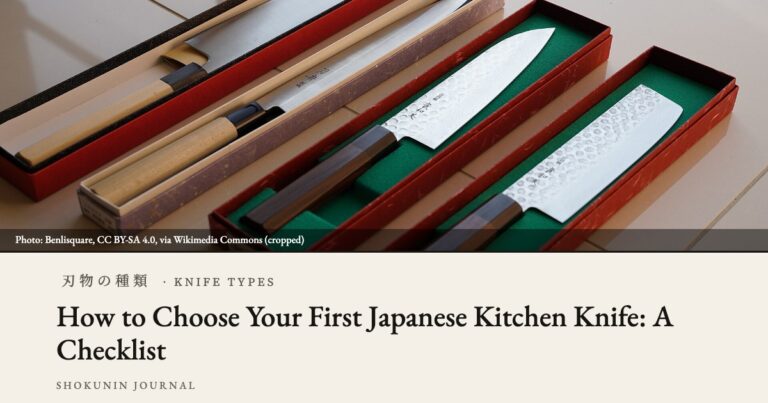
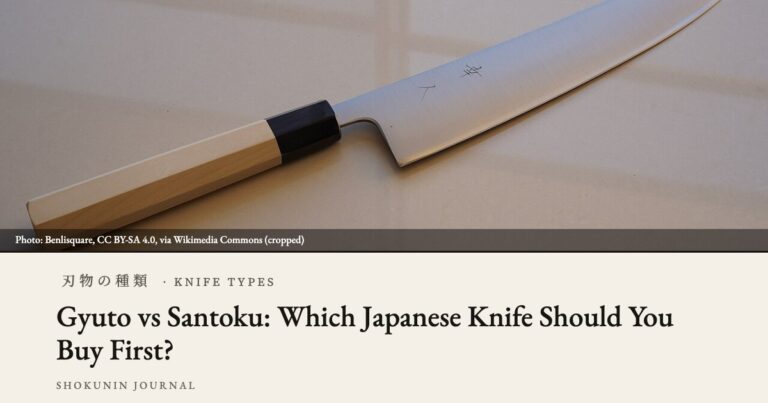
For a first Japanese knife, our guides compare the santoku and the gyuto. The makers and retailers we checked suggest a santoku, about 165–180 mm (6.5–7.1 in), for home cooking, beginners and vegetables, and a gyuto, 180 mm (7.1 in) and up, for larger food, Western-style cooking and sliding cuts. Both handle most everyday cooking. See Gyuto vs Santoku.
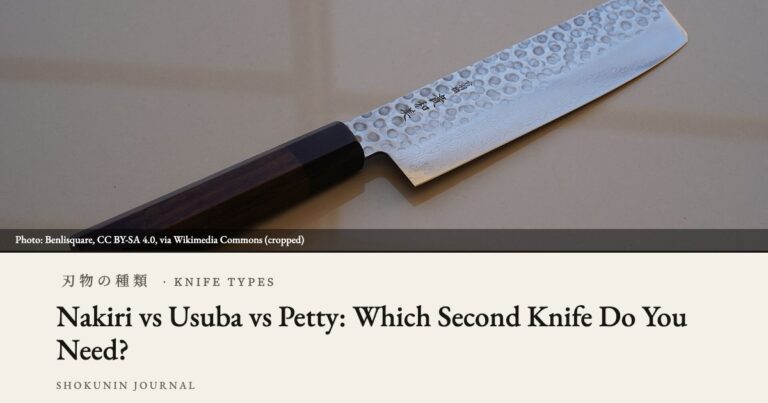
If the person already owns one of those, a second knife is the other option. Tojiro, Jikko and KAI all suggest a petty knife as the second knife after a santoku or gyuto, and Tojiro also suggests a nakiri for someone who cuts a lot of vegetables into thin strips. None of the makers we checked recommends an usuba as a home cook’s second knife. See Nakiri vs Usuba vs Petty.
2. Carbon steel or stainless?
Shirogami (White paper) and Aogami (Blue paper) are carbon steels made by Proterial. They can rust, so they need drying after use. GIN3, VG-10 and SG2 are stainless steels. See Japanese Knife Steels.
Words such as kurouchi, nashiji or Damascus in a listing describe the finish, meaning how the blade surface looks and feels. A finish is not the steel. See Japanese Knife Finishes.
3. Is the cook left-handed?
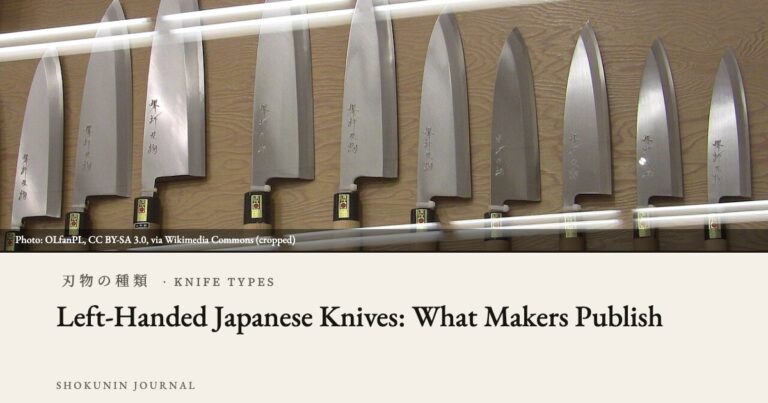
Tojiro and Global say their double-bevel knives can be used with either hand, while Jikko, Kama-Asa and Korin describe some double-bevel edges as ground for right-handers. Single-bevel knives such as the deba and yanagiba are made in separate left-handed versions. See Left-Handed Japanese Knives.
4. Knives we have compared
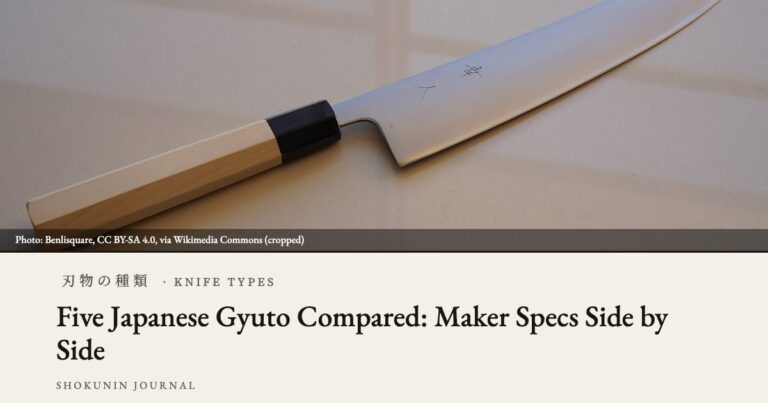
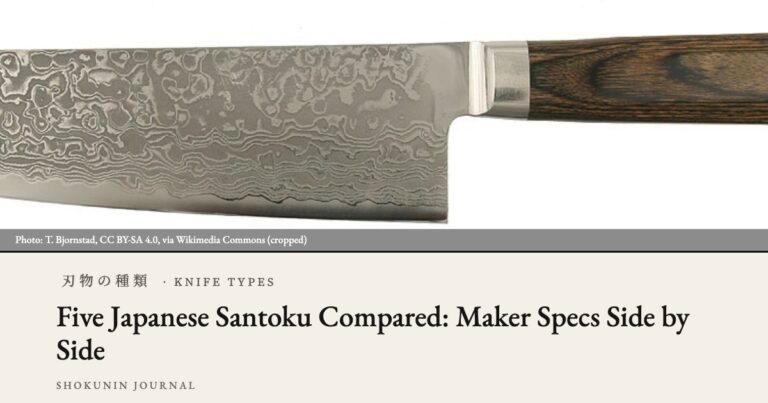
These ten knives come from our two comparison articles, which use makers whose official websites publish specifications. Listing them here is not a ranking. The country of manufacture is shown as the product page states it; where the page does not say, we say so. For the other specifications and the makers’ prices in Japan, see Five Japanese Gyuto Compared and Five Japanese Santoku Compared.
| Knife | Blade length | Blade steel, as stated | Country of manufacture, as stated on the product page |
|---|---|---|---|
| Gyuto | |||
| Tojiro CLASSIC Gyuto 210 mm (F-808) | about 210 mm (8.3 in) | Core VG-10, clad with 13-chrome stainless steel | Not stated on the product page (the shop’s site title describes its knives as Tsubame-Sanjo-made) |
| KAI Seki Magoroku Damascus Gyuto 210 mm (AE5205) | 210 mm (8.3 in) | Stainless clad: “high-carbon stainless cutlery steel” edge, stainless sides (steel grade not named) | Japan |
| Global G-2 Gyuto 20 cm | 20 cm (7.9 in) | “Stainless steel for cutlery (with molybdenum and vanadium)” | Not stated |
| Masahiro MV-S Gyuto 210 mm (No. 13611) | 210 mm (8.3 in) | Masahiro’s own stainless steel MBS-26 | Not stated (the company is in Seki, Gifu) |
| Suncraft MOKA Chef’s Knife 200 mm (MK-01) | about 200 mm (7.9 in) | “Molybdenum vanadium stainless steel” (steel grade not named) | Japan; the page also cites the Seki no Hamono regional brand |
| Santoku | |||
| Tojiro CLASSIC Santoku 170 mm (F-503) | about 170 mm (6.7 in) | Core VG-10, clad with 13-chrome stainless steel | Not stated on the product page (the shop’s site title describes its knives as Tsubame-Sanjo-made) |
| KAI Seki Magoroku Damascus Santoku 165 mm (AE5200) | 165 mm (6.5 in) | Stainless clad: “high-carbon stainless cutlery steel” edge, stainless sides (steel grade not named) | Japan |
| Global G-46 Santoku 18 cm | 18 cm (7.1 in) | “Stainless steel for cutlery (with molybdenum and vanadium)” | Not stated |
| Masahiro MV-S Santoku 175 mm (No. 13623) | 175 mm (6.9 in) | Masahiro’s own stainless steel MBS-26 | Not stated (the company is in Seki, Gifu) |
| Yaxell Kaneyoshi-saku VG10 Santoku | 16.5 cm (6.5 in) | Three-layer steel, VG10 core | Japan |
If you live outside Japan, our guide to makers’ own policies on overseas orders is Where to Buy Japanese Knives Outside Japan.
5. A gift for someone who already has a good knife
If the person already has a knife they like, a whetstone is another option. Makers suggest starting with one medium stone of around #1000: Tojiro says one medium stone is enough to start, Global says a medium stone is enough for home use, and Sakai Ichimonji Mitsuhide suggests starting with a medium stone and adding coarse and finishing stones later. Among the stones Shapton suggests for household knives are its #1000 and #5000 from the Kuromaku line. Some stones must be soaked before use and others should not be; follow the stone maker’s instructions. See Japanese Whetstone Grits and Japanese Knife Care.
6. 2026 holiday shipping dates in the U.S.
For delivery by December 25, 2026 within the contiguous United States (the lower 48 states), USPS recommends these send-by dates:
| USPS service | Send by |
|---|---|
| USPS Ground Advantage | Thursday, December 17 |
| Priority Mail | Friday, December 18 |
| Priority Mail Express | Saturday, December 19 |
For Alaska, Hawaii, Puerto Rico and U.S. territories, USPS gives the same dates for Priority Mail and Priority Mail Express. For Ground Advantage it gives no single send-by date and says packages to or from these locations generally take 10 days or longer, varying by location.
See also: How to Choose Your First Japanese Kitchen Knife.
Sources
- U.S. Postal Service: 2026 Holiday Shipping Deadlines (checked November 1, 2026)
- Knife specifications, makers’ suggestions and steel facts: the sources listed at the end of each Shokunin Journal article linked above.
2 Comments
Comments are closed.